Doubles Strategy for Beginners: Where to Stand, When to Move

Quick Answer: Doubles is won at the net, not the baseline, so your main job as a beginner is positioning — get to the net with your partner, move together like you’re tied by a rope, and cover the middle before the lines. Master those three habits and you’ll beat teams who out-hit you but still play parallel singles.
You and your partner are both camped on the baseline, trading polite groundstrokes with the other team, and somehow you’re still losing 6-2. Sound familiar? That’s not a skill gap — it’s a positioning gap. Doubles rewards where you stand almost as much as how you hit.
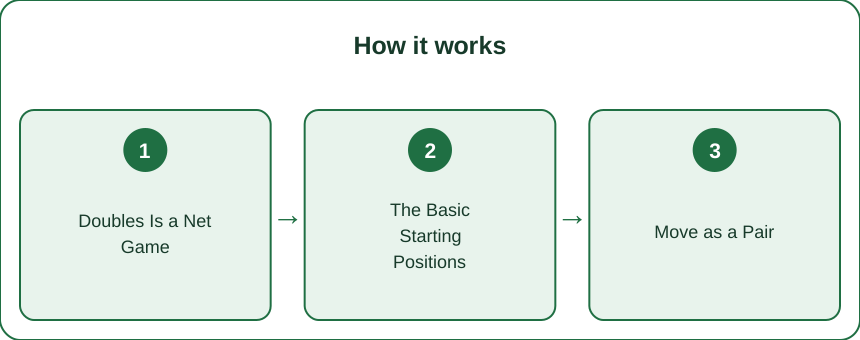
Why is doubles a net game instead of a baseline game?
Here’s the thing most beginners don’t realize: points in doubles are won at the net far more often than from the baseline. Two players standing at the net cut off angles that would be wide open in singles, and the team that controls the net controls the point.
Your goal on nearly every point is simple: get to the net first, together. Whoever gets there controls the rally from that moment on.
Where should each player stand to start the point?
Starting position depends on whether your team is serving or returning:
- Server’s partner starts at the net, ready to poach or put away a weak return.
- Returner’s partner starts around the service line — close enough to move in fast, far enough back to cover a lob or a hard shot at the feet.
These two spots balance attack and defense. From there, everything is movement with purpose, not standing still and hoping.

How should you and your partner move together on court?
Picture a rope tied between you and your partner. When one of you shifts left, you both shift left. When one advances toward the net, the other advances too.
You’ll typically be side-by-side at the net or briefly staggered during a transition, but you should never be stranded — one player at net, one stuck at the baseline, with a canyon of open court between you. That gap is exactly where opponents aim, and for good reason: gaps between partners are where points go to die.
Which shots should you prioritize covering — the middle or the lines?
Cover the middle first. Most winning shots in club-level doubles go up the middle, not down the line, because the middle is the shortest path over the lowest part of the net and it splits two players who both think it’s “the other person’s ball.”
When you’re unsure who should take a shot, protect the center and make your opponents attempt the riskier alley shot instead. Let them go for the low-percentage line winner and miss wide — you take the easy middle ball all day.
How much does communication actually matter in doubles?
More than most beginners expect. Call “mine,” “yours,” “switch” — early, and loudly enough that your partner actually hears it over the wind and the other team’s grunting.
Good communication beats good technique surprisingly often at the beginner level. Two solid players who talk will beat two better players who don’t, more often than you’d think. Loud teams win quiet points.
Mistakes everyone makes in beginner doubles
“Mistakes Everyone Makes”
- Both players camping the baseline. It feels safe, but it hands the net — and the point — to any team willing to take it.
- Advancing alone. One partner creeps forward while the other stays back, opening the exact gap opponents are trained to find.
- Staying silent on 50-50 balls. Two players watching the same ball sail past untouched because neither called it is one of the most common ways club teams lose points.
- Chasing line winners instead of owning the middle. The flashy down-the-line shot has a much lower success rate than most beginners think.
- Standing flat-footed after the serve. The fifth habit is the one that even intermediate players never fully break — and it costs more points than any single stroke flaw.
Mini FAQ
Where should the server’s partner stand in doubles?
At the net, typically near the service line on their side, ready to poach any weak return or put away a short ball. This is an attacking position from the very start of the point.
Why do most doubles points get won up the middle?
The middle shot travels the shortest distance over the lowest part of the net, and it often falls between two players who both assume it’s their partner’s ball. That hesitation is exactly what makes it such a reliable target.
How do you avoid leaving a gap between doubles partners?
Move together, not independently — treat it like you’re connected by a rope, shifting and advancing as a unit. If one of you can’t get to the net safely, both of you hold back together instead of splitting the court.
TL;DR
- Doubles is won at the net, not the baseline — get there first, together.
- Server’s partner starts at net; returner’s partner starts near the service line.
- Move as a pair, side-by-side or briefly staggered, never stranded apart.
- Cover the middle first; let opponents miss the risky alley shots.
- Call the ball loudly and early — communication beats raw technique at this level.
- Avoid the classic mistakes: both camping the baseline, advancing alone, and staying silent on 50-50 balls.
See It in Motion
Seen here: UPF 50+ Pleated Running Skort with 26” Leggings & Pockets — shop similar styles on bubblelime.com
Keep Reading
This article is for general informational purposes only and is not medical advice. It is not a substitute for professional diagnosis or treatment. Always consult a qualified healthcare provider about your individual situation, especially before making significant changes to your diet or exercise routine.