The Serve Toss Problem Nobody Diagnoses Correctly
Quick Answer: An inconsistent toss is almost never a hand problem. In roughly four out of five recreational players it traces back to one of three things: a moving base (your feet or hips shift during the toss), a bent tossing elbow that adds a second variable joint, or a grip that squeezes the ball. Fix the base first, then the elbow, then the grip — in that order. Practising a thousand tosses without diagnosing which one you have just makes the wrong pattern more automatic.
You have heard the advice. Toss the ball like you are placing it on a high shelf. Toss it into a hoop. Toss a hundred a day.
If that had worked, you would not be reading this. The reason it does not work for most people is that the toss is the last link in a chain, and the break is usually two links earlier.
Here is how to find yours.

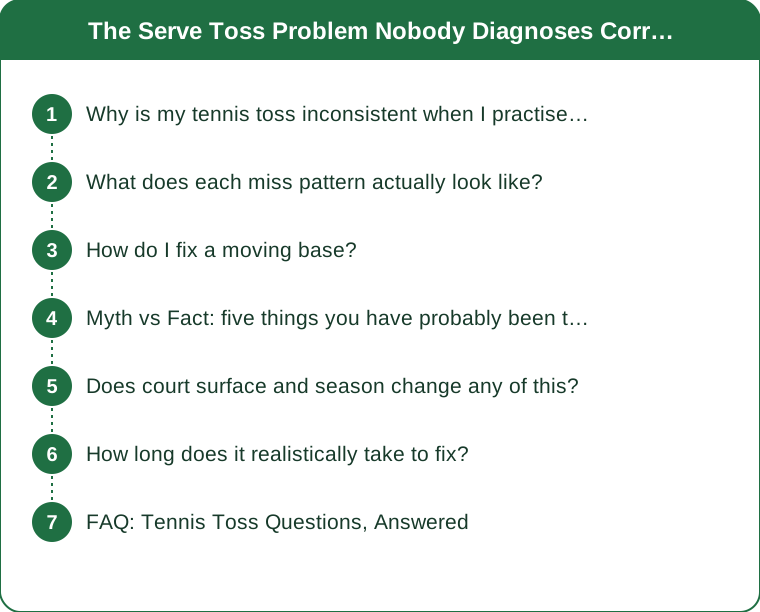
Why is my tennis toss inconsistent when I practise it every day?
Because you are practising the symptom, not the cause.
The toss looks like a hand action, so people rehearse the hand. But the ball leaves your fingers at the end of a movement that started at the ground. If your base moves — a rocking hip, a heel that lifts early, a front foot that slides — then your shoulder is travelling while your hand is releasing. The hand can be perfect and the ball will still land somewhere different every time.
There is a simple test. Stand at the baseline, set up to serve, and have someone film you from the front at normal speed. Watch only your belt line. If the belt line drifts left, right, or forward before the ball leaves your hand, you have a base problem and nothing you do with your fingers will fix it.
The second most common cause is a bending tossing elbow. A straight arm has one joint controlling the ball’s path: the shoulder. A bent arm has two, and two joints must be timed against each other on every single serve. That is a coordination problem you do not need to have.
The third is grip pressure. Players who squeeze the ball release it late and with spin, and a spinning toss curves. Hold it in your fingertips, palm slightly open, the way you would hold an egg you intend to put down rather than throw.
Each of these produces a different miss pattern, which is what makes them diagnosable.
What does each miss pattern actually look like?
Film four serves and note where the ball goes. The pattern tells you which fault you have.
Toss lands behind you, varying amounts. Almost always a base fault — specifically, your hips rotating open early. You are effectively tossing from a platform that has already turned. The ball goes where the shoulder was pointing at release, and the shoulder keeps moving.
Toss lands in front, into the court, low. Usually a bent elbow released too early, often combined with rushing. The arm never gets to full extension, so the release point is lower and the ball has to be thrown rather than lifted, which adds velocity error.
Toss drifts left or right (for a right-hander, usually left). Grip pressure and finger release. You are rolling the ball off the side of your hand. This one is the easiest to fix and the most satisfying to feel change.
Toss height varies but placement is consistent. This is a purely muscular timing issue and it is the good problem to have — it means your base and arm path are fine. Fix it by defining a physical end point: your arm should finish fully extended with the hand at a fixed height, and the ball should leave at the top of that motion, not mid-way through it.
Write down which of the four you are before you change anything. Guessing costs weeks.
How do I fix a moving base?
Take the toss out of it entirely for the first ten minutes.
Drill one — the wall lean. Stand with your back foot about six inches from a wall or fence in your serve stance. Go through your full service motion without a ball. If your back hip contacts the wall during the wind-up, you are rocking backward. Repeat until you can complete the motion without contact.
Drill two — the coin. Place a coin under the arch of your front foot. Serve. If the coin moves, your front foot is sliding or pivoting during the toss phase. The front foot may pivot after the toss; it should be quiet before it.
Drill three — toss and freeze. Toss the ball, then hold your entire body completely still and let the ball drop. It should land within a hand’s width of a spot roughly twelve inches in front of your front foot and slightly to your hitting side. Do this twenty times and mark where the balls land with cones or a jacket. A tight cluster means the base is solved. A scattered field means keep drilling.
The freeze drill is uncomfortable because your instinct is to swing. That discomfort is the point — it isolates the toss from everything downstream and shows you the truth.
Give the base a full practice session before touching anything else. Most players find that fixing the base alone tightens the toss by half.

Myth vs Fact: five things you have probably been told about the toss
Myth: You should toss the ball as high as possible so you have time. Fact: A higher toss spends longer being affected by wind and requires more precise timing on the way down. The ball only needs to peak slightly above your maximum reach with the racquet. Higher is not more forgiving; it is less.
Myth: A good toss has no spin. Fact: A little spin is unavoidable and harmless. What matters is that the spin is the same every time, because consistent spin means consistent release. Chasing zero spin makes people tense their hand, which makes everything worse.
Myth: You should catch bad tosses. Fact: Yes — but most players catch the obviously bad ones and hit the marginal ones. The marginal ones are what teach your body that variable tosses are acceptable. Set a rule for one practice session: if the ball does not land in your marked zone, you catch it, no exceptions. It is humbling and it works.
Myth: The toss should be at one o’clock. Fact: Toss position depends on the serve you are hitting. Flat serves sit further forward and to the hitting side; kick serves sit further back and further over your head. If you toss every serve to the same clock position, you are telegraphing your serve to anyone paying attention.
Myth: Wind makes the toss unfixable. Fact: Wind makes the toss lower. In real wind, shorten your toss and accept a slightly compressed motion. The third one on this list is the one that surprises most club players.
Does court surface and season change any of this?
More than people expect, and early autumn is when it starts to matter.
Cooler air is denser. A ball tossed on a 10°C September morning behaves marginally differently from the same toss in August heat — it decelerates a touch faster on the way up and the peak arrives a hair sooner. This is a small effect, but combined with the next one it is not nothing.
Cold hands release differently. This is the big one. Finger proprioception drops measurably in cold conditions, and the toss is a fingertip action. If you play early mornings from September onward, your first three service games will have a worse toss than your last three regardless of technique. Plan for it: warm your hands properly, and if you serve first in a cold match, use a slightly lower toss for the opening game.
Wind patterns change with the season. Autumn tends to bring gustier, less predictable wind than midsummer. Gusty wind is worse for the toss than steady wind, because you cannot compensate for it consistently. Lower toss, faster motion.
Surface matters indirectly. On clay, players tend to stand further behind the baseline and the serve motion lengthens slightly; on fast hard courts it compresses. Neither changes the toss mechanics, but a motion you have grooved on one surface will feel different on the other, and people misread that as a toss fault.
None of these is a reason to rebuild anything. They are reasons to expect variance and not panic about it.
How long does it realistically take to fix?
Shorter than you fear, if you diagnose correctly. Longer than you would like, if you do not.
A grip-pressure fault is often gone in one session. It is a conscious change, it feels different immediately, and there is very little motor relearning involved.
A bent-elbow fault typically takes two to four weeks of deliberate practice. You are changing an arm path that has been automated, and automated patterns resist. Expect to feel worse before you feel better — usually around day four or five, when the old pattern and the new one are competing.
A base fault takes the longest, commonly four to eight weeks, because you are changing how you stand, and standing is deeply automatic. The good news is that fixing your base tends to improve your groundstrokes and your movement at the same time, so the return on the time is high.
A realistic practice structure: ten minutes of shadow motion without a ball, twenty tosses with the freeze drill, then thirty serves at seventy percent effort focusing only on the toss, then hit normally. Roughly one hour, twice a week.
Do not track your serve percentage during this period. It will dip. Track toss placement instead — count how many out of twenty land in your marked zone — and let the percentage take care of itself once the pattern settles.
FAQ: Tennis Toss Questions, Answered
Should I use a different toss for second serves?
Usually yes, slightly. Most second serves carry more spin, which means the contact point sits a little further back over your head. Trying to hit a kick serve off a flat-serve toss forces you to arch your back to reach it, which is both less effective and harder on your lower back over time.
Is it bad that I toss with a bent arm if I have always done it?
Not automatically. Some very good players do. The question is whether your toss is consistent — if you are landing twenty out of twenty in a small zone with a bent arm, leave it alone. Change it only if the bend is producing scatter.
My toss is fine in practice and terrible in matches. What is that?
Almost always grip pressure and breathing, not technique. Under pressure people squeeze harder and hold their breath, both of which degrade fine motor control. Add a physical routine before each serve — two bounces, one breath out — and it usually resolves without touching the mechanics.
TL;DR:
- An inconsistent toss is usually caused by a moving base, a bent tossing elbow, or excess grip pressure — diagnose before you drill.
- Film four serves from the front and match your miss pattern: behind you means base, short and low means elbow, sideways means grip.
- Fix the base first with the wall lean, coin, and toss-and-freeze drills; a tight landing cluster means it is solved.
- Expect one session for grip, two to four weeks for the elbow, four to eight weeks for the base — and track toss placement, not serve percentage, while you rebuild.
The toss feels like the simplest part of tennis and behaves like the hardest, and that gap is entirely because everyone practises it as a hand skill. Treat it as a whole-body skill and it becomes tractable. Spend one session diagnosing rather than repeating, and you will save yourself the several hundred aimless tosses that most players grind through every season without improving.
See It in Motion
Seen here: UPF 50+ Pleated Running Skort with 26” Leggings & Pockets — shop similar styles on bubblelime.com
Keep Reading
This article is for general informational purposes only and is not medical advice. It is not a substitute for professional diagnosis or treatment. Always consult a qualified healthcare provider about your individual situation, especially before making significant changes to your diet or exercise routine.