The Complete Guide to Your First League Night or Club Match
Quick Answer: Most club league nights run a rotating format where you play short timed sets or first-to-a-number games with changing partners, and the whole point is social play rather than tournament competition. Arrive 15 minutes early, bring more balls than you think, know how to call your own lines, and say at the start that it is your first time - every club handles this constantly and it removes ninety percent of the anxiety. Your level matters far less than your reliability and your court manners.
You have been hitting for months. You can rally, you can serve, you have a decent backhand on a good day. And you have been putting off league night for eight weeks because you do not know what actually happens when you walk in. Here is all of it.

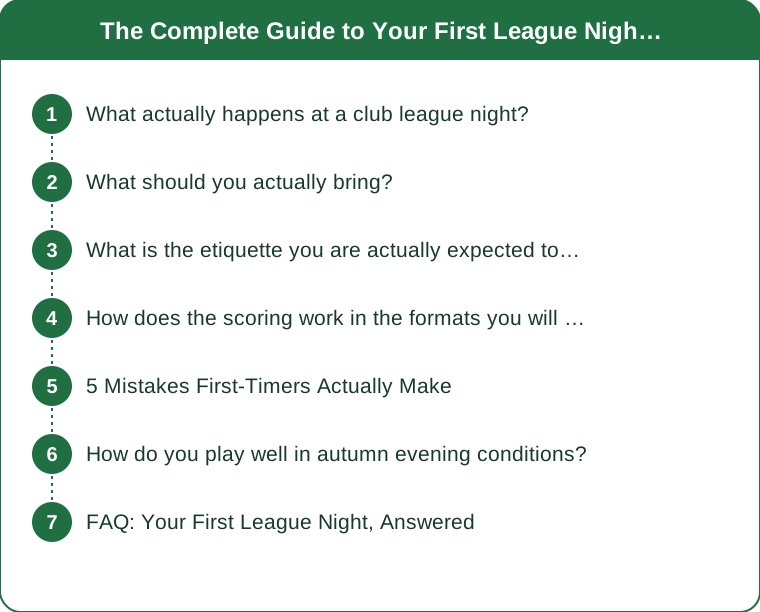
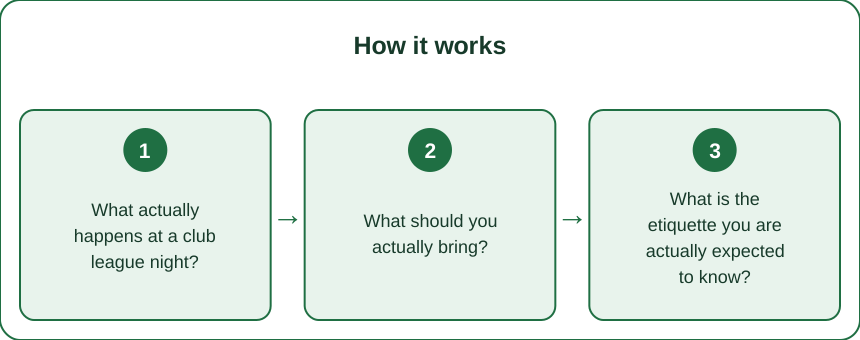
What actually happens at a club league night?
Most clubs run one of three formats, and it is worth asking which before you go.
Rotating social doubles. The most common beginner-friendly format. You are assigned to a court, play a short set or a timed block - usually 15 to 25 minutes - and then rotate, often with a partner change. You may play with four or five different partners in a night. This format is designed so that a mismatch only lasts twenty minutes.
Fixed-pair league. You and a regular partner play scheduled matches against other pairs, usually best of three short sets. More competitive, more commitment, generally not the place to start.
Ladder or box league. You are in a group of four to six players of similar level, and you arrange your own matches over a month. Flexible, but it requires you to actually message strangers and book courts, which is a different kind of barrier.
The typical evening runs 90 minutes to two hours with a fixed start. Some clubs assign courts by ability, some deliberately mix. Ask which when you sign up - it changes what to expect enormously.
And the crucial part: almost nobody there is playing seriously. League night at most clubs is closer to a running club than a tournament. People are there for a regular social hit, and the standard varies wildly within any given evening.
What should you actually bring?
Your racquet, and ideally a second if you own one. Strings break, and they break at the least convenient moment. If you only own one racquet, that is completely fine - most clubs will have someone who can lend you one for a set.
A fresh-ish can of balls. Etiquette at most clubs is that people contribute balls across the season. Turning up with a new can occasionally is normal; turning up empty every week is noticed.
Court shoes, not running shoes. This matters more than any other equipment decision. Running shoes have no lateral support and roll ankles on lateral movement. They also damage some court surfaces, and some clubs will turn you away.
Layers you can shed and re-add. Autumn evening play means you arrive cold, warm up over twenty minutes, and then cool fast between rotations. A light jacket you can pull on while waiting is the difference between a comfortable evening and a stiff one.
Water, a towel, and a grip. Overgrips cost very little and a slippery grip in cool damp evening air is a real problem.
Something with sugar in it for hour two. Two hours of stop-start play in cool air burns more than people expect, and the standard drops noticeably at the end of the night for players who have not eaten since lunch.
What is the etiquette you are actually expected to know?
You call the lines on your side, and your opponent calls theirs. You do not call balls on your opponent’s side, even if you had a better view. If you genuinely cannot tell, the ball is good - the benefit of the doubt goes to your opponent. This is the single most important rule in recreational play and the source of nearly all friction.
Call out immediately and clearly. A late or mumbled call is worse than a wrong one. If you called out and then realize you were wrong, say so and give the point.
Announce the score before every serve, server’s score first. This prevents the most common recreational dispute, which is not a line call but two people remembering a different score.
Do not walk behind a court while a point is being played. Wait at the back until the point ends. This is the etiquette rule newcomers break most often, and it is the one that visibly annoys people.
Return balls to the server directly, not with a casual tap in the general direction. And if a ball rolls onto your court from another, call let immediately and stop the point.
Say good shot when someone hits one, and do not apologize repeatedly for your own misses. Constant apologizing is well-meant and it makes partners uncomfortable. One acknowledgment is plenty.
Do not coach your partner unless they ask. This applies at every level and it is the fastest way to have an unpleasant evening.

How does the scoring work in the formats you will actually meet?
Standard tennis scoring: 15, 30, 40, game. At deuce, most social leagues play a sudden-death point rather than advantage, to keep the timing predictable. Ask at the start which your club uses - this varies and nobody minds being asked.
Timed sets. Play until the horn or the clock, and whoever is ahead wins. If you are mid-game, that game usually does not count. Simple, and it means everyone finishes at once.
Short sets, first to four games. Common in rotating formats. Often a tiebreak at 3-3.
Pickleball leagues usually play to 11, win by 2, with only the serving side scoring in traditional scoring - though many recreational leagues use rally scoring, where every rally scores. These are meaningfully different games tactically, so ask.
Serving rotation in doubles. Your pair alternates serving games with the opposing pair, and within your pair you alternate each time it is your turn. Whoever served first in the set continues in that slot. If everyone loses track, agree a fresh order and carry on - nobody will care.
Nobody expects you to know all of this on night one. Say it is your first league night at the start of the first rotation and someone will walk you through the local version in thirty seconds.
5 Mistakes First-Timers Actually Make
1. Arriving exactly on time. Courts are assigned and warm-ups start promptly. Arriving at the stated time means you are warming up cold while everyone else has started. Fifteen minutes early is the standard.
2. Not warming up properly in cool weather. Autumn evening play on cold muscles is where calf strains and rolled ankles happen. Ten minutes of easy movement before you hit - jogging, side steps, arm circles, and gentle serves - is not optional once it is under 60°F.
3. Trying to play their best shots. League night is not the place to attempt the winner you land one time in five. Consistency wins recreational doubles overwhelmingly. Get the ball back, aim for the middle, and let the errors come from the other side.
4. Being the person who chases every ball at the wrong moment. In doubles, poaching everything from your partner is far more annoying than missing a shot. Cover your side, call mine clearly when you go for a ball in the middle, and let it go if you did not call it.
5. Silently deciding they are too bad to be there. Almost every first-timer thinks this, and almost none of them are right. The range within a single social league night is enormous, and reliability - turning up, being pleasant, keeping the ball in play - is valued far above shot quality.
How do you play well in autumn evening conditions?
The ball behaves differently in cold air. Cold balls are less bouncy and travel less far, so shots that were landing deep in August will land short in October. Expect to hit with slightly more depth and to see fewer balls fly long.
Change balls more often as temperatures drop. A can that would last three sessions in summer goes dead faster in the cold. If the ball feels heavy and low, it is not your technique.
Damp courts change the bounce and the footing. Evening dew on a hard court makes the surface slick well before it looks wet, especially in the corners and along the baseline. Shorten your steps and stop sliding.
Floodlights change your depth perception, particularly on high balls. Overheads and lobs are meaningfully harder under lights. Give yourself an extra step back and expect the first few to feel strange.
Your grip gets slippery in cool damp air, not just in heat. A fresh overgrip before a league night is a fifteen-second fix for a problem that affects every shot.
Keep your jacket on between rotations from about mid-October. Sitting out a twenty-minute rotation in a damp t-shirt is how the second half of your evening gets worse and how you wake up stiff.
FAQ: Your First League Night, Answered
What if I am much worse than everyone else?
In a rotating format, a mismatch lasts one rotation, and most clubs deliberately mix levels. If after a few weeks it is genuinely wrong, most clubs run more than one night at different standards - ask the organizer, who would much rather move you than lose you.
Do I need to join the club to attend?
Usually yes for a league, though many clubs offer a couple of trial sessions for non-members. Ask specifically about a taster session rather than assuming you have to commit to a year.
What do I do if someone makes a line call I disagree with?
Accept it and move on. Recreational tennis runs entirely on the honor system, and disputing calls is far more damaging to your evening than losing a point. If it happens repeatedly with the same person, that is a conversation for the organizer, not the court.
Should I bring a partner or go alone?
Go alone. Rotating formats are built for solo arrivals and pair you up on the night, and turning up alone is the normal way people join. Arriving as a fixed pair can actually complicate a rotation, and it removes the main social benefit of the format.
What happens if it rains?
Outdoor clubs usually make the call an hour or two before and message the group, so check your phone before you set off. Many clubs have indoor or covered courts as a backup, and some simply move the night. Ask the organizer how they handle it when you sign up - autumn weeks are exactly when this comes up.
How fit do I need to be?
Fitter than you expect for the stop-start pattern, but the level is self-selecting and there are players of every fitness level in a typical social league. The most common complaint from newcomers is not being out of breath, it is stiff legs the next day - which passes after a few weeks.
TL;DR:
- Most club league nights are rotating social doubles with short timed sets and changing partners - a bad matchup lasts twenty minutes, not two hours.
- Arrive 15 minutes early, bring court shoes, layers, a can of balls, and a fresh overgrip.
- Call your own lines only, give the benefit of the doubt to your opponent, announce the score before every serve, and never walk behind a live court.
- Play consistent rather than spectacular, do not coach your partner, and say it is your first night - it removes almost all the awkwardness immediately.
- In autumn evenings, warm up longer, expect a shorter cold-ball bounce, watch for dew, and keep your jacket on between rotations.
The barrier to league night is almost never your forehand. It is not knowing the format, and now you do. Turn up early, keep the ball in play, and be pleasant - that is genuinely the whole job. Do it three weeks running and you will stop thinking of yourself as the new person, which is the only part that was ever actually hard.
See It in Motion
Seen here: UPF 50+ Adjustable A-Line Running Skort with Pockets — shop it on bubblelime.com
Keep Reading
This article is for general informational purposes only and is not medical advice. It is not a substitute for professional diagnosis or treatment. Always consult a qualified healthcare provider about your individual situation, especially before making significant changes to your diet or exercise routine.