The Complete Guide to Tennis Footwork When Late-Season Courts Slow Down
Quick Answer: Late-season courts play slower because cool overnight air leaves moisture in the surface and worn balls fluff up. Slower balls sit up higher and arrive later, which wrecks footwork timed to a faster court. The fix is not running harder - it is splitting later, taking one more adjustment step, and standing about a metre further inside the baseline than you did in July.
You did not get worse in three weeks. The court did. Every year around the end of August the same complaint shows up on club courts: the ball is not coming through, my timing is gone, I feel late on everything. Players respond by swinging earlier and harder, which is precisely the wrong adjustment. Footwork is the lever here, not the racquet.

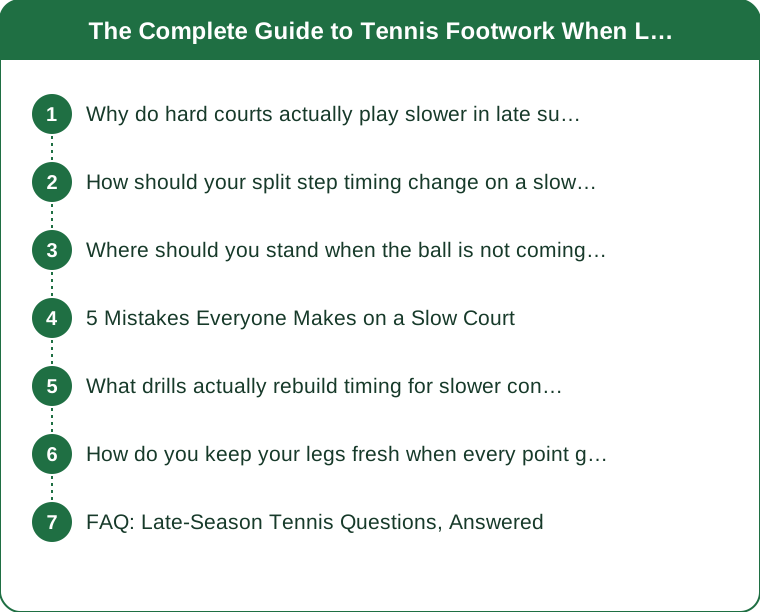
Why do hard courts actually play slower in late summer?
Three things change at once, and they all point the same direction. None of them is dramatic on its own. Together they add up to a ball that arrives noticeably later than it did six weeks ago.
Overnight moisture is the biggest one. As nights cool, the temperature of the court surface drops below the dew point far more often than it does in midsummer. Acrylic hard court is textured with sand for grip, and that texture holds a thin film of moisture well past sunrise. A damp textured surface grips the ball for a few extra milliseconds on the bounce, which bleeds pace and kicks the ball upward.
Cooler air is denser. Air density rises as temperature falls, so a ball travelling at the same speed through 18C air sheds more velocity than through 30C air. It is not a huge effect over one bounce, but across a full rally it stacks.
And the balls themselves are older. Club ball cans get stretched further at the end of a season. Felt that has fluffed up creates more drag and a fatter contact patch on the bounce. A three-week-old ball on a damp court is a completely different projectile from a fresh ball on a hot one.
The practical read: the ball arrives later, sits up higher, and carries less forward momentum into your strings. Your footwork was calibrated for the opposite of all three.
How should your split step timing change on a slow court?
Split later, not earlier. This is the single adjustment that fixes the most problems, and it is counterintuitive enough that most club players never try it.
The split step should land as your opponent makes contact - that is the standard cue, and it is correct on a normal court. But the purpose of the split is to be airborne and unweighted at the exact moment you need to read direction and push off. On a slow court the ball takes longer to arrive, so if you split on their contact you land, wait, and then have to re-load your legs from a static position. That second load is where the heaviness comes from.
Try splitting a beat after contact. Roughly a tenth to two tenths of a second - it feels alarmingly late for about ten minutes, then it feels obvious. You want to be landing out of your split as the ball crosses the net, not before it has left their strings.
Watch your own landing width. A split that lands too wide is a split you cannot push out of. Feet slightly outside shoulder width, weight into the balls of the feet, knees soft. On a slow court you will be covering less ground per shot but doing it more often, so a compact, repeatable split beats a dramatic one.
The self-check: if you find yourself hopping twice before moving, you split too early. One hop, then go.
Where should you stand when the ball is not coming through?
Move in. Most players do the opposite. When timing feels off, the instinct is to back up and give yourself more room. On a slow court that is exactly wrong - backing up means you take the ball later, in the descending phase, with even less pace to work with.
A metre inside your July position is a reasonable starting point. If you normally stand a step behind the baseline in rallies, get your toes near the line. If you already stand on the line, look for chances to step inside it on anything short.
Take the ball on the rise where you can. A ball that sits up gives you a longer window in the rising phase, which is the one moment when the court is giving you free pace back. It requires early preparation and a shorter backswing, but you are borrowing the energy the court took away.
Recovery position also shifts. Slower balls mean your opponent has less ability to hurt you with angle, so you can recover slightly narrower and closer than you would in fast conditions. Sprinting back to a wide midsummer recovery spot after every ball is unnecessary work.
One caution: standing inside the baseline against a heavy topspin player on a court that kicks the ball up is a losing trade. Read the specific opponent, not just the rule.

5 Mistakes Everyone Makes on a Slow Court
1. Swinging harder to compensate. The ball is slow because the surface and the air took energy out of it. Adding racquet head speed on a low-percentage swing path adds errors, not winners. Add depth and shape instead - a heavier ball with more net clearance keeps your opponent pinned back where the slow court hurts them too.
2. Skipping the adjustment step. On a fast court you often get one big step and then hit. On a slow court you have time for a small final adjustment step, and using it is the difference between hitting from balance and hitting from a lunge. Most players have the time and simply do not take the step because they are already committed.
3. Standing tall between shots. Cooler air makes people stiffen up. A tall, straight-legged ready position adds a full extra movement - stand up, sink down, push off - to every single ball. Stay low between shots even when it feels unnecessary.
4. Blaming the racquet or the strings. Every autumn, string tension gets dropped by two kilos across club courts. Sometimes that is right. But if the problem is that you are late, softer strings will make you later, not earlier.
5. Warming up like it is July. A five-minute warm-up that worked at 30C does not work at 18C. Cold calf and hip flexor tissue is the direct cause of the sluggish first-set footwork most players blame on the court. Give it twelve to fifteen minutes with actual movement in it - side shuffles, three sets of eight split-step-and-push reps, a few short sprints - before you hit a ball in anger.
What drills actually rebuild timing for slower conditions?
Drill one: the late-split shadow drill. No ball. Partner or coach points a direction. You split, then move. The entire point is to feel yourself land out of the split into the movement rather than landing and then deciding. Three sets of ten direction calls, full rest between sets. Do it before you hit, not after you are tired.
Drill two: rising-ball feeds from the service line. Stand inside the baseline. Partner feeds high, slow, loopy balls. You take every one on the rise with a short backswing. Twenty balls per side. This feels awful for the first ten and then something clicks. It is the most directly transferable drill on this list.
Drill three: two-ball recovery. Feed to one corner, then immediately to the other. You must recover through the middle with a proper split before the second ball. Eight to ten pairs, ninety seconds rest. It builds the recovery-and-reload pattern that a slow court demands more often.
Drill four: dead-ball depth targets. Cooperative rally with a target zone from the service line back to the baseline. Twenty consecutive balls in the zone before you stop. On a slow court, depth is worth more than pace, and this trains you to value it.
Frequency: twice a week for three weeks is enough to reset timing. Doing it once and declaring it did not work is the most common outcome.
How do you keep your legs fresh when every point gets longer?
Accept that the workload changed. Slower courts mean longer rallies, and longer rallies mean more direction changes per match. A two-hour match in September can involve substantially more total accelerations than the same two hours in July, even though it felt less intense.
Train the calf and the hip in the off-court week. Calf raises - three sets of fifteen, slow lower, done from a step for range - are the least glamorous and most protective thing you can do for a court player in cool conditions. Add a hip hinge movement and single-leg balance work. Twice a week, twenty minutes.
Layer for the first thirty minutes and mean it. A light long sleeve for the warm-up and the first few games keeps muscle temperature where it needs to be. Peel it off once you are actually sweating, not before. Muscle that cools between sets is stiffer for the first four points of the next one.
Fuel differently than you did in summer. People drink much less when they are not visibly sweating, which is how autumn cramping happens. You are still losing fluid at 18C. Drink on a schedule, not on thirst.
And use the changeover properly. Sitting completely still for ninety seconds in cool air is a recipe for a slow first point. Stay moving lightly for the last twenty seconds before you stand up.
FAQ: Late-Season Tennis Questions, Answered
Should I change my string tension when the weather cools?
A small drop - one to two kilos - can restore some feel as strings stiffen in cool air, and it is a legitimate adjustment. But do it after you have fixed your footwork and positioning, not instead. If you drop tension while still standing too far back, you will just hit long more often.
Is it worth switching to a different ball?
Yes, more than most players think. A fresh, pressurised ball in cool conditions plays dramatically differently from a three-week-old one. If your club allows it, opening a new can for a match in late season is the cheapest performance change available.
My knees ache more on cool damp courts. Is that normal?
Mildly stiffer joints in cool conditions and a longer warm-up requirement are common and usually unremarkable. Pain that persists after warm-up, swelling, or a knee that gives way is a different category. See a physiotherapist or physician rather than working around it. This is general information, not medical advice.
TL;DR:
- Late-summer courts play slower because of overnight moisture, denser cool air, and fluffier worn balls - the ball arrives later and sits up higher.
- Split later, roughly a beat after your opponent’s contact, so you land out of the split into your movement instead of reloading from static.
- Stand about a metre further in than you did in July and hunt for balls on the rise, where the court gives pace back.
- Add depth and shape rather than racquet head speed - swinging harder is the classic slow-court error.
- Warm up for twelve to fifteen minutes with actual movement, and train calves and hips twice a week.
None of this is a rebuild. It is a recalibration, and it takes about three sessions to feel normal. The players who struggle through September are the ones who keep playing July tennis on an August court and conclude that something has gone wrong with their game. Adjust the feet first, and the strokes usually sort themselves out.
See It in Motion
Seen here: UPF 50+ Pleated Running Skort with 26” Leggings & Pockets — shop similar styles on bubblelime.com
Keep Reading
This article is for general informational purposes only and is not medical advice. It is not a substitute for professional diagnosis or treatment. Always consult a qualified healthcare provider about your individual situation, especially before making significant changes to your diet or exercise routine.