Tennis Elbow Recovery: The Complete Timeline From First Twinge to Full Return
Quick Answer: Mild tennis elbow can resolve in 3-6 weeks with early rest and proper loading exercises, while more established cases commonly take 6-12 months for full recovery — the timeline depends heavily on how early it’s addressed and whether the underlying mechanical cause (usually grip or technique) actually gets corrected.
Tennis elbow has a reputation for dragging on indefinitely, and for a lot of people it genuinely does — often specifically because the same mechanical stress that caused it never actually gets addressed during recovery, leaving the tendon fighting an uphill battle against the exact motion that damaged it in the first place. Here’s a realistic, stage-by-stage look at what recovery actually involves, from the first twinge through full, confident return to play.

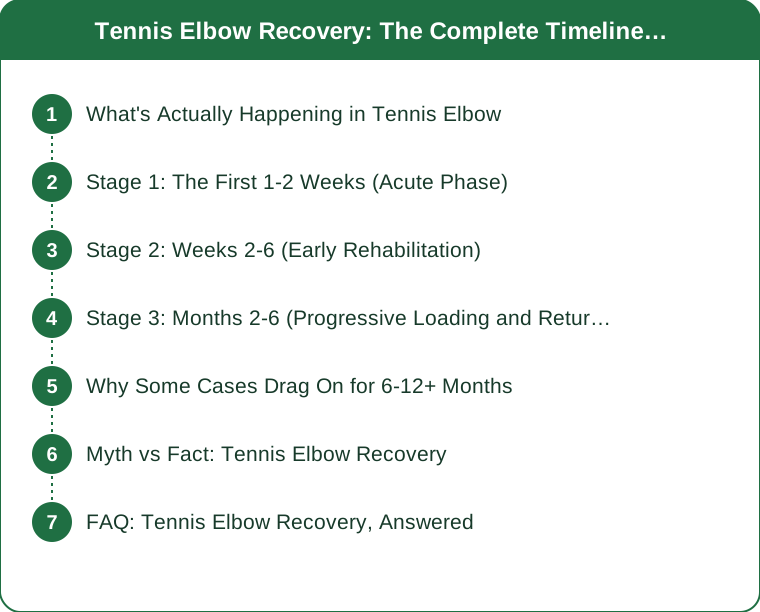
What’s Actually Happening in Tennis Elbow
Tennis elbow (lateral epicondylitis) is a repetitive strain injury to the tendons that attach the forearm’s extensor muscles to the outside of the elbow, most commonly from repeated wrist extension and gripping motions under load — a tennis backhand is the classic cause, but it’s just as common from other repetitive gripping tasks like painting, typing with poor wrist position, or manual labor involving a lot of forearm rotation.
Despite the ‘-itis’ in the medical name suggesting pure inflammation, research over the last two decades has shown that established cases involve more tendon degeneration (small collagen fiber breakdown and disorganization, a condition more accurately called tendinosis) than active inflammation, which is a big part of why rest alone often isn’t enough to fully resolve it — a degenerated tendon needs a stimulus to rebuild organized collagen, not just time off.
The specific tendon involved is the extensor carpi radialis brevis, which attaches right at the bony bump on the outside of the elbow (the lateral epicondyle) and takes the brunt of the load every time the wrist extends against resistance — whether that’s a one-handed backhand, twisting a screwdriver, or repeatedly lifting a coffee mug during a bad flare-up. Understanding that it’s this one specific tendon under repeated, concentrated stress (rather than general elbow ‘wear and tear’) is part of why targeted rehabilitation of that exact tendon, rather than generic elbow rest, is what actually drives recovery.
Stage 1: The First 1-2 Weeks (Acute Phase)
Early symptoms — pain with gripping, tenderness on the outside of the elbow, discomfort during backhand or twisting motions — respond best to relative rest from the aggravating activity, ice for symptom control (10-15 minutes, several times a day), and avoiding the specific loaded gripping motions that provoke pain, without necessarily stopping all activity entirely. This is the window where addressing it early has the biggest payoff: cases caught and rested in the first 1-2 weeks have measurably better odds of a fast, full resolution than cases where play continues through the pain, since early intervention prevents the acute strain from progressing into the more stubborn degenerative tendinosis pattern.
Stage 2: Weeks 2-6 (Early Rehabilitation)
Once acute pain settles, the focus shifts to gentle, progressive loading rather than continued complete rest — research consistently shows that appropriately loaded tendons heal with better organized collagen structure than tendons kept completely immobile, since controlled load actually guides how new collagen fibers align as they form. Eccentric wrist extensor exercises (slowly lowering a light weight through wrist extension) are the most well-studied intervention at this stage, typically done in sets of 10-15 reps, several times a week, starting light and progressing gradually as tolerated.
This stage often also introduces isometric holds (static holds against light resistance) as a lower-irritation entry point for people whose pain flares with the eccentric motion itself, giving the tendon load exposure without the same mechanical stress. A typical progression might start with isometric holds only in week 2-3, add slow eccentric lowering by week 3-4 once isometrics are pain-free, and introduce light concentric (lifting) work by week 5-6 — the exact pace varies by individual, and pushing to the next stage before the current one is comfortably pain-free is a common way this stage gets derailed and stretched out longer than it needs to be.

Stage 3: Months 2-6 (Progressive Loading and Return to Play)
This stage is where a lot of recoveries stall, specifically because the underlying mechanical cause — often grip size, string tension, or backhand technique — doesn’t get addressed alongside the exercise program, meaning the tendon is rebuilding capacity while simultaneously being re-exposed to the exact stress pattern that broke it down in the first place. Working with a coach or physical therapist to identify and correct the actual mechanical driver, alongside continued progressive strengthening, is what separates full recoveries from the frustrating ‘better then worse again’ cycle a lot of people experience across a season.
Return to play is typically graduated — reduced volume and intensity first, full return only once grip strength and pain-free range of motion are both restored, and often introduced shot by shot (starting with easier forehand-dominant rallies before reintroducing backhand-heavy drills) rather than jumping straight back into full match play.
Why Some Cases Drag On for 6-12+ Months
Cases that become chronic (generally defined as symptoms persisting beyond 6 months) are usually cases where the mechanical cause was never corrected, where rehabilitation exercises were stopped once pain improved rather than continued through full tendon remodeling, or where return to play happened too aggressively too soon after the first pain-free days. Tendon tissue remodels slowly — meaningfully slower than muscle, since tendon has considerably less blood supply supporting the repair process — which is part of why the full timeline for established cases genuinely does run longer than most people expect or want to hear, regardless of how motivated they are to speed it up.
Another common contributor to chronic cases is inconsistent adherence to the exercise program itself — eccentric and isometric protocols only work when done consistently over months, and a program done sporadically (a burst of enthusiasm for two weeks, then skipped for a month once things feel better) doesn’t give the tendon the steady, repeated loading stimulus the research protocols are actually built around. Chronic cases also sometimes involve secondary compensations that develop during the injury — altered shoulder or grip mechanics adopted to avoid pain — which can persist as bad habits even after the original tendon issue resolves, requiring separate attention during the return-to-play phase.
Myth vs Fact: Tennis Elbow Recovery
Myth: complete rest for as long as it takes is the safest recovery approach. Fact: extended complete rest without any loading is associated with worse long-term outcomes than a properly progressed loading program — some controlled load is part of the healing process, not a risk to avoid entirely, since tendon tissue specifically needs mechanical stimulus to remodel in an organized, strong way.
Myth: once the pain is gone, you’re fully recovered. Fact: pain often resolves before full tendon strength and remodeling is complete, which is why returning to full intensity play immediately after pain-free days is a common cause of relapse — continuing the strengthening program for several more weeks past pain-free is genuinely part of full recovery, not an optional extra step.
Myth: switching to a two-handed backhand permanently solves the underlying problem. Fact: it can reduce load on the affected side in the short term, but it doesn’t correct whatever grip, string tension, or technique issue originally caused the injury, meaning the underlying risk factor often remains unaddressed even if the specific symptom temporarily improves.
FAQ: Tennis Elbow Recovery, Answered
Do I need to see a doctor or physical therapist, or can I recover on my own?
Mild, early cases often improve with self-directed rest and eccentric exercises, but a physical therapist becomes valuable specifically for identifying the mechanical cause and correcting technique — the piece that’s hardest to self-diagnose accurately from the inside of your own swing.
What about braces or straps — do they actually help?
A counterforce brace (worn just below the elbow) can reduce symptom intensity during activity for some people by redistributing load away from the tendon attachment point, though it’s a symptom-management tool alongside rehab, not a substitute for the exercise program itself.
What treatment options exist for cases that don’t respond to months of standard rehab?
For genuinely stubborn cases, options include corticosteroid injections (which can reduce pain short-term but have mixed longer-term evidence and don’t address the underlying tendon degeneration), platelet-rich plasma (PRP) injections (with growing but still developing evidence for stimulating tendon repair), and shockwave therapy — all of these are generally considered after a solid trial of structured rehabilitation hasn’t worked, not as a first-line approach.
When is it safe to fully return to regular play?
Generally once grip strength has returned to within about 90% of your unaffected side and you can complete your normal training load pain-free for at least 1-2 weeks — returning right at the first pain-free day is the most common setup for relapse and undoes much of the progress made getting there.
Does equipment really make a meaningful difference, or is that overstated?
Grip size and string tension have genuine biomechanical evidence behind their role in tennis elbow risk — an oversized grip or overly tight string bed increases the shock transmitted to the forearm tendons on impact, so this isn’t a minor or overstated factor, it’s frequently the actual root cause that rehab alone can’t fix.
How much does overall arm and shoulder strength matter, beyond just the forearm exercises?
More than most people expect — weak shoulder and upper back muscles often force the forearm and elbow to compensate during a stroke, absorbing load that should be distributed further up the kinetic chain, which is why a comprehensive rehab program frequently includes shoulder and scapular strengthening alongside the forearm-specific work, not just wrist exercises in isolation.
Is it common to need to change racquet or string setup permanently, or just temporarily during recovery?
For cases where equipment was a clear contributing factor, the change is often kept permanently rather than reverted after recovery, since simply returning to the exact setup that contributed to the original injury reintroduces the same risk factor that needs to stay addressed long-term, not just during the rehab window.
Can tennis elbow come back after a full, successful recovery?
Yes, particularly if the same combination of factors (mechanical cause, training load, insufficient warm-up) reappears — a full recovery reduces risk considerably but doesn’t grant permanent immunity, which is part of why many players who’ve been through a serious case continue their strengthening exercises in a lighter, maintenance form indefinitely rather than dropping them entirely once symptoms resolve.
Does age play a role in how long recovery takes?
Older tendons generally have somewhat reduced blood supply and slower baseline collagen turnover compared to younger ones, which can extend the realistic recovery timeline modestly, though the same core principles — early intervention, progressive loading, correcting the mechanical cause — apply regardless of age and remain the biggest levers within a person’s control.
Does playing on a different court surface change tennis elbow risk during recovery?
Harder surfaces transmit more shock through the arm on impact than softer clay-type surfaces, so temporarily favoring a softer surface during the return-to-play phase, where available, can reduce the load on a still-recovering tendon compared to jumping straight back onto hard courts at full intensity.
This is general information, not medical advice — a doctor or physical therapist can assess your specific case and stage of recovery.
TL;DR:
- Mild, early-caught cases often resolve in 3-6 weeks; established cases commonly take 6-12 months
- Complete rest alone often isn’t enough — properly progressed loading is part of real recovery
- The mechanical cause (grip, technique, equipment) has to be corrected, or relapse is common
- Pain resolving doesn’t mean full recovery — continue strengthening past the pain-free point
- Stubborn cases have further options (injections, shockwave therapy) after a fair trial of standard rehab
The cases that drag on for a year usually aren’t unlucky — they’re cases where the underlying mechanical cause never got fixed alongside the exercises. Address both, and the timeline moves toward the shorter end.
See It in Motion
Seen here: UPF 50+ Pleated Running Skort with 26” Leggings & Pockets — shop similar styles on bubblelime.com
Keep Reading
This article is for general informational purposes only and is not medical advice. It is not a substitute for professional diagnosis or treatment. Always consult a qualified healthcare provider about your individual situation, especially before making significant changes to your diet or exercise routine.