The Complete Mechanical Breakdown of Why Your Tennis Serve Loses Power
Quick Answer: Serve power comes from a sequential kinetic chain — legs, hips, torso rotation, shoulder, and finally the arm and wrist — and a break at any single link in that chain reduces total power output more than most players realize, regardless of how hard the arm swings.
Most players trying to add serve power focus entirely on the arm and racket speed. The actual power source is a full-body sequential chain, and understanding each link explains why isolated arm strength rarely fixes a weak serve on its own.

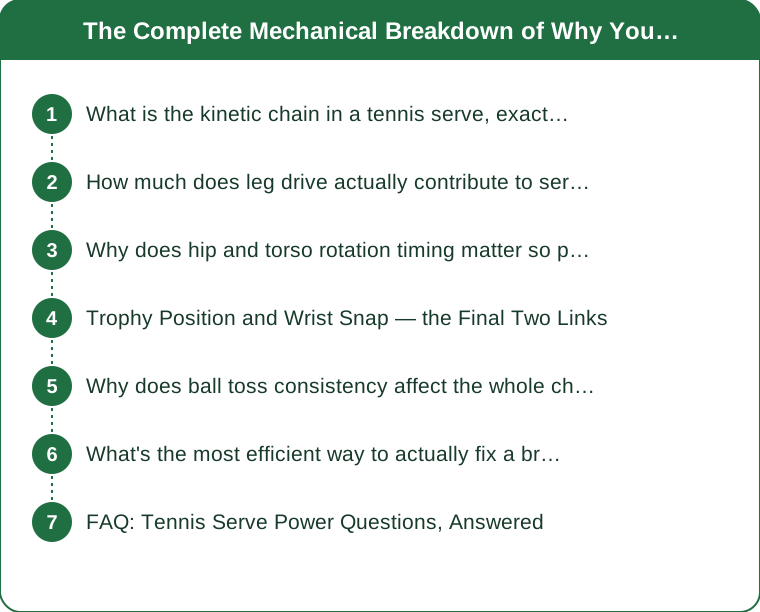
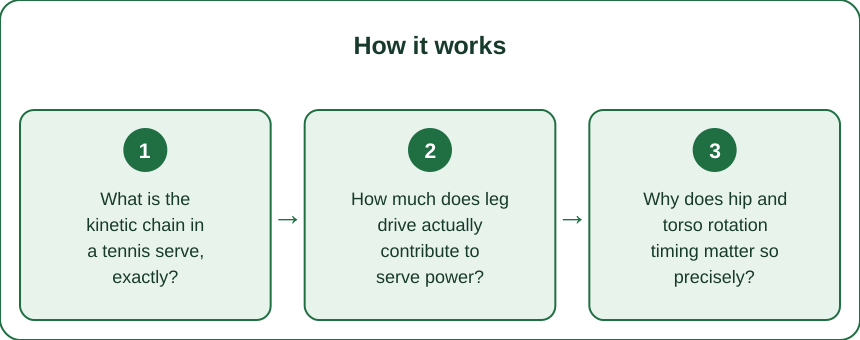
What is the kinetic chain in a tennis serve, exactly?
The serve’s power generation moves sequentially through the body: legs and ground force first, then hip rotation, then torso rotation, then shoulder, then arm, then wrist and racket — each segment transfers energy to the next in a specific timed sequence, similar to cracking a whip. A break or mistiming at any link reduces how much energy successfully transfers to the final racket-head speed, even if every individual segment is strong in isolation.
How much does leg drive actually contribute to serve power?
More than most recreational players use — a proper leg drive (bending the knees during the loading phase, then driving upward as the swing begins) contributes ground reaction force that becomes the base of the entire chain. Players who serve from a mostly static lower body are starting the chain without its foundational power source, which no amount of arm speed fully compensates for.
Why does hip and torso rotation timing matter so precisely?
The hips should begin rotating slightly before the shoulders and torso, creating a stretch between hip and shoulder rotation sometimes called separation or the X-factor — this stretch stores elastic energy that releases into the upward swing. Rotating hips and shoulders together, at the same time, loses this stored energy and is one of the most common invisible power leaks in recreational serves.

Trophy Position and Wrist Snap — the Final Two Links
What role does the trophy position and arm path actually play?
The trophy position — racket up, tossing arm extended, weight loaded on the back leg — sets up the shoulder to whip through an efficient arc; a collapsed or rushed trophy position shortens this arc and reduces the time and range over which the shoulder can accelerate the arm. This is a timing and positioning issue more than a strength issue.
How does wrist snap (pronation) factor into final racket speed?
The forearm pronation and wrist snap through contact is the final link in the chain, converting accumulated rotational energy into racket-head speed at the moment of contact — but this only adds meaningful power if the earlier links (legs, hips, torso, shoulder) have already built up energy to transfer. A strong wrist snap on a chain that’s broken earlier only marginally helps, which is why isolated wrist-strengthening exercises rarely fix a serve that’s weak for other reasons.
Why does ball toss consistency affect the whole chain?
An inconsistent toss forces the body to adjust its position and timing mid-swing to reach the ball, which disrupts the carefully sequenced hip-shoulder-arm timing described above — a serve can have perfect individual mechanics and still lose power simply because the toss placement forced a compensation somewhere in the chain.
What’s the most efficient way to actually fix a broken kinetic chain?
Working backward from ball toss consistency (the foundation everything else depends on), then leg drive, then hip-shoulder separation timing, tends to produce more reliable power gains than focusing on arm speed or wrist snap first — those final-link elements can only convert energy that the earlier links have actually generated.
FAQ: Tennis Serve Power Questions, Answered
Can I add serve power just by getting stronger in the gym?
General strength helps somewhat, but a broken kinetic chain limits how much of that strength actually transfers to racket speed — technique work on sequencing typically produces bigger gains than strength training alone for most recreational players.
How long does it take to fix a serve with broken chain timing?
Meaningful timing changes often take several weeks of focused practice to feel natural, since the body needs to relearn a specific sequenced movement pattern, not just build strength.
Does this kinetic chain concept apply to pickleball serves too?
Pickleball’s underhand serve motion is mechanically different and relies much less on this full sequential chain, since the shot generates far less power by design — this breakdown is specific to tennis’s overhead serve.
TL;DR:
- Serve power flows sequentially: legs, hips, torso, shoulder, arm, wrist — in that order
- Leg drive provides the foundational ground force most recreational serves skip
- Hip-shoulder separation timing stores elastic energy that simultaneous rotation loses
- Wrist snap only adds power if earlier links already generated energy to transfer
- Toss consistency underlies the whole chain’s timing
Fixing a weak serve usually means fixing the sequence, not just swinging harder.
See It in Motion
Seen here: UPF 50+ Adjustable A-Line Running Skort with Pockets — shop it on bubblelime.com
Keep Reading
This article is for general informational purposes only and is not medical advice. It is not a substitute for professional diagnosis or treatment. Always consult a qualified healthcare provider about your individual situation, especially before making significant changes to your diet or exercise routine.