The Complete Guide to Playing on Public Courts
Quick Answer: Public courts run on three things: a booking system that varies by council or city, an unwritten etiquette code around waiting and rotating, and your own ability to find people to hit with. Learn the booking app for your area, arrive knowing the standard courtesy rules - wait behind the fence rather than walking behind a live point, one hour is the default if people are waiting, and retrieve balls only between points - and use local apps, noticeboards, and community sessions to build a hitting list. The single biggest barrier is not skill; it is not having anyone to play with, and that is a solvable problem.
The courts are right there, free, and empty at 8am. The hard part turns out to be everything except the tennis.
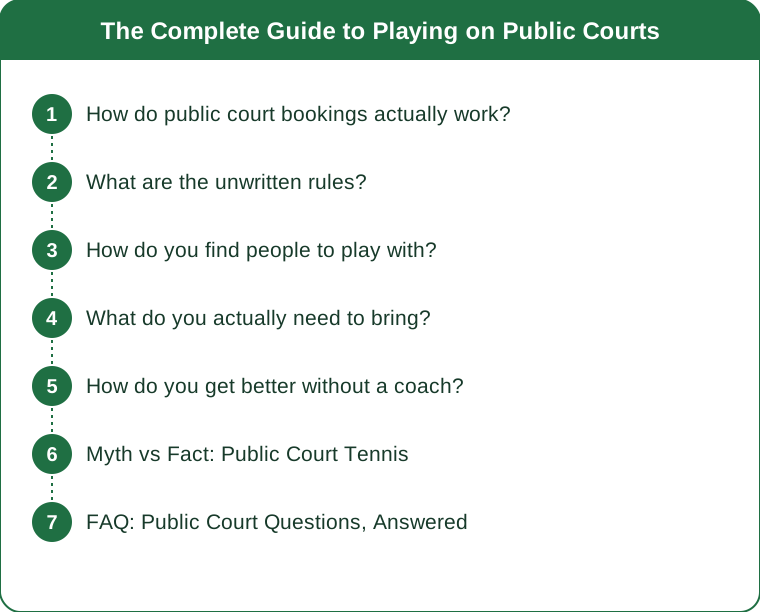
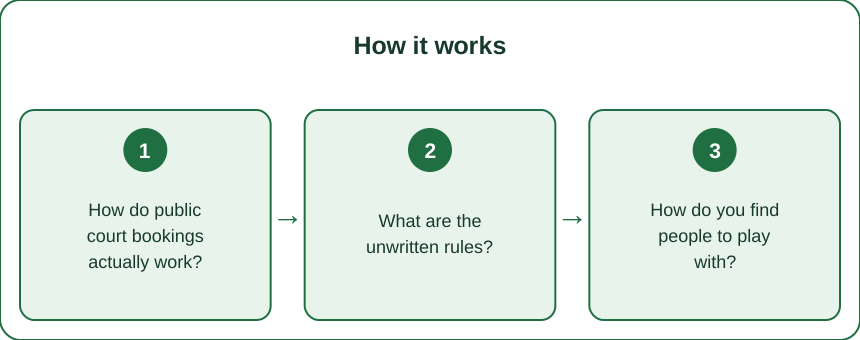
How do public court bookings actually work?
There is no single system, which is why this is confusing, but the models are few and you will be on one of them.
Model 1: Free and first come, first served. Turn up, and if the court is free, play. The most common arrangement at smaller parks. The etiquette load is highest here because there is no booking to point to - the queue is managed socially.
Model 2: Free but bookable online. Increasingly common. Courts are gated with an access code delivered when you book. The advantage is certainty; the disadvantage is that popular slots vanish quickly.
Model 3: Paid by the hour, booked online. Typically modest, often with off-peak discounts. Frequently the same system as model 2 with a charge attached.
Model 4: Court key or council permit. Some sites issue a season key or a permit for a small annual fee, which is usually excellent value if you play weekly.
How to find out which applies to yours:
- Check the gate. Signage nearly always states the system and the site name you need for the booking app.
- Search your local council or parks department website for tennis courts. National tennis bodies also maintain court finders that link straight to booking.
- Look for a QR code on the gate, which is the current default for access-controlled courts.
The timing that gets you a court
- Weekday mornings before 10am are the emptiest slots almost everywhere.
- Weekday afternoons before school ends are the second best.
- Weekday evenings from 5pm to 8pm are the peak. In summer this is fiercely contested; expect to book days ahead.
- Weekend mornings book out first of anything.
- The shoulder season is your friend. Once evenings shorten, evening demand collapses on unlit courts, and lit courts become the contested asset instead.
Cancellation is not a formality. Booked-and-unused courts are the main reason these systems get criticised, and cancelling a slot you cannot use takes ten seconds and frees it for someone else.
What are the unwritten rules?
This is what makes people nervous about turning up alone, and it is a short list once written down.
Waiting and rotating:
- If courts are full and there is no booking system, one hour is the accepted default for singles, sometimes 90 minutes for doubles. Some sites post it; where they do not, it is still the norm.
- Make yourself visible - stand where the people playing can see you, and they will usually acknowledge you and tell you how long they have left. Standing out of sight and then feeling aggrieved is the common failure.
- Never open the gate mid-point. Wait until the point ends.
During play:
- Do not walk behind a court while a point is in progress. Wait at the fence. This is the rule most often broken and the one that most irritates people, because it interrupts play.
- If your ball rolls onto another court, wait until their point finishes, then call out ball please. Never run on to fetch it.
- If a ball comes onto your court, hold the point - stop and replay it rather than continuing. Then return their ball, ideally by rolling it along the back, not smashing it back over the net.
- Call your own lines honestly, and if you are unsure, the point goes to your opponent. This is the actual convention in unofficiated tennis and it is worth knowing.
General courtesy:
- Announce the score before every serve in a match. It prevents almost every disagreement.
- Keep noise reasonable. This is a bigger issue with pickleball, where the sound carries and has generated genuine community friction in a number of places. Being conscious of nearby housing matters.
- Take your rubbish, including ball tubes and tape.
- Do not coach loudly from the side of someone else’s court.
Shared courts and lines everywhere
Many public courts now carry both tennis and pickleball lines, and portable nets appear. The convention is that the court’s booked purpose wins. If you booked for tennis, you are not obliged to share; if the court is first-come, negotiate rather than assume. Most conflicts here come from one group assuming a prior claim that was never established.
How do you find people to play with?
The genuine barrier for most people, and the part with the most options once you look.
Apps and online:
- Dedicated tennis partner apps match by level and location, and are the fastest route in most cities. Your level is stated on a standard rating scale - be honest, since overstating produces one bad match and then nobody.
- Local social media groups for your park or area. Frequently far more active than any app.
- Community and neighbourhood apps, which are surprisingly effective for finding beginners nearby.
In person:
- Turn up to a cardio tennis or social session. Many public sites run coached group sessions cheaply, and their real value is that everyone there is also looking for people to hit with.
- Board or noticeboard at the courts. Old-fashioned, still works.
- Local leagues run informal ladder formats where you arrange your own matches. Excellent structure for people who want games rather than social hitting.
- Ask. People at public courts are, in general, glad to be asked. The worst outcome is no.
When you have nobody at all:
- Wall practice. A backboard or a solid wall builds more than people expect - consistency, footwork, and rhythm. Twenty minutes against a wall is a genuine session.
- Serve practice alone. A basket of balls and an empty court is the highest-value solo practice in tennis, because serving is the only stroke you fully control and the one most people neglect.
- Ball machine hire, where available.
On level matching, which decides whether it is fun: a gap of one level on a standard rating scale is workable and often good for both. Two levels is frustrating for both people. Rather than describing yourself as a beginner or intermediate, describe what you can do - I can rally 10 balls crosscourt, my serve goes in about half the time - which is far more informative and avoids most mismatches.
What do you actually need to bring?
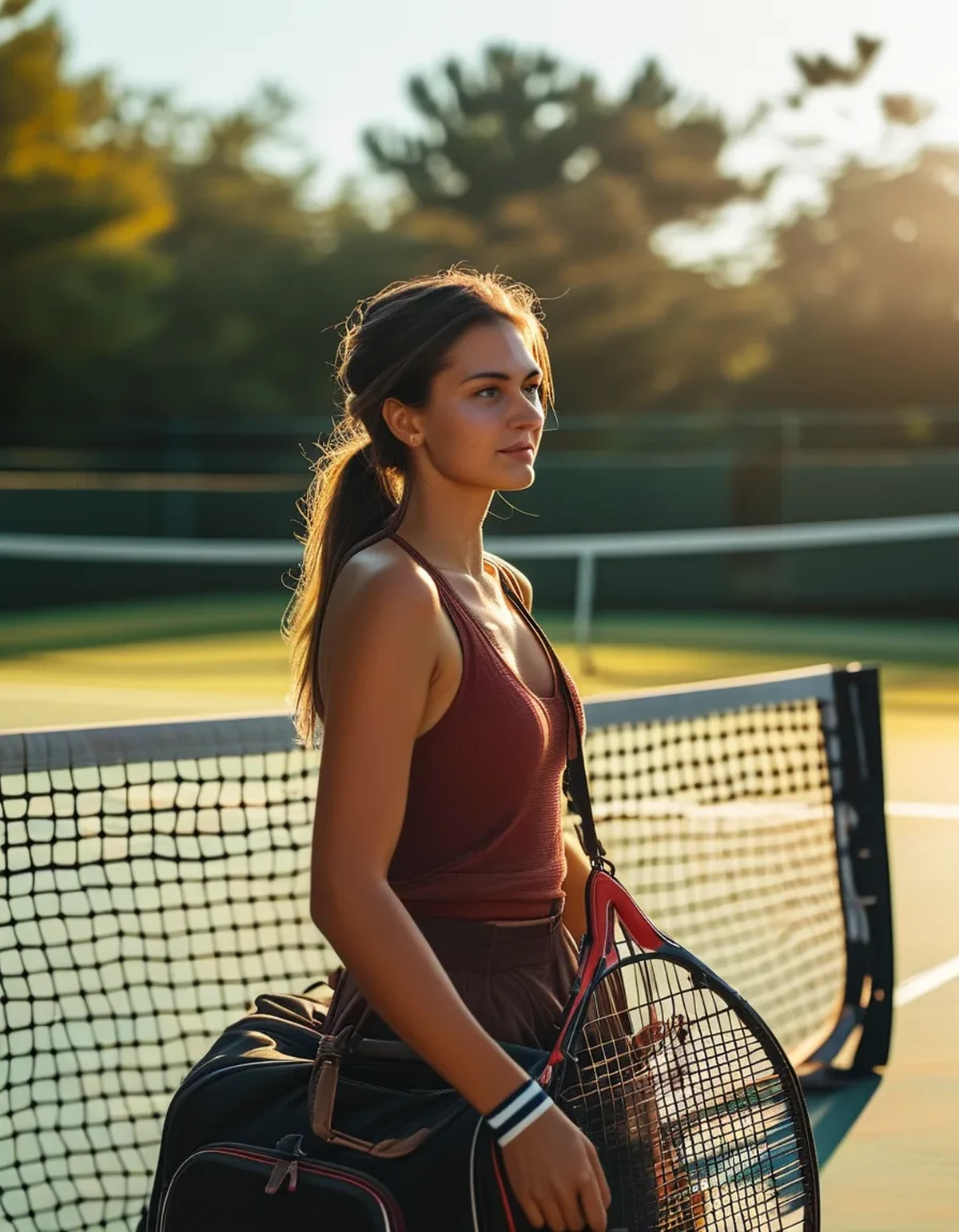
Public courts provide the surface and usually a net. Everything else is yours.
Essential:
- A racket appropriate to your level. A heavier, smaller-headed racket is harder for beginners; a larger head with a lighter frame is more forgiving. If you inherited a racket, check the grip size and the string condition - strings lose tension over months even unused, and a very old string bed makes everything harder.
- Balls. A tube of three is standard, but for practice more is better - chasing balls eats a session. Pressureless balls last far longer and are ideal for wall and machine practice, though they feel heavier.
- Court shoes, not running shoes. This is the one that matters for injury. Running shoes are built for forward motion with a soft, high heel, and tennis is lateral. Ankle rolls on public courts happen most often in running shoes, and the sole pattern also grips wrong on hard courts.
- Water, more than you think. Many public sites have no fountain.
Strongly recommended:
- Overgrips. Cheap, and they transform a slippery grip, particularly in humidity.
- A hat and sunscreen. Court surfaces reflect, and a two-hour session in open sun adds up quickly.
- A towel.
Worth having:
- Spare balls in a separate bag, so you do not lose a whole session to one lost ball.
- A small first aid kit with blister plasters and tape.
- A padlock, if the site has an unattended gate or your bag sits outside the fence.
On court condition, which is the public court trade-off. Surfaces vary from excellent to genuinely poor. Check before you commit to a long session: standing water and slick patches after rain, moss in shaded corners, cracks that change the bounce, and net height and tension, which is often wrong. A sagging net is common and worth adjusting if the crank works.
If a court is genuinely unsafe - large cracks, persistent standing water, broken glass - report it to the council or the operator. These reports are how public courts get repaired, and very few people make them.
How do you get better without a coach?
Public court players tend to plateau in a specific way: they rally comfortably and then never improve, because unstructured hitting is not practice.
Structure a session instead of just hitting:
- 10 minutes: warm-up. Mini-tennis inside the service boxes, which warms up the arm gradually and is better than starting at the baseline.
- 20 minutes: one specific thing. Crosscourt forehands only. Or backhands down the line. Or first serve to the deuce court. One target per session is the rule that produces change.
- 20 minutes: rally with the intention of consistency, counting the longest rally you can build.
- 10 minutes: points or serve practice.
The three highest-return things for most self-taught players:
- Serve practice alone. Most people’s serve is the weakest stroke and it requires no partner. A basket of balls, 20 minutes, twice a week, changes matches faster than anything else.
- Footwork - split step and recovery. Standing still and reaching is the defining habit of self-taught tennis. Split step as your opponent strikes, and move back toward the middle after every ball.
- Consistency over power. In recreational tennis the large majority of points end in an error rather than a winner. Aiming higher over the net and deeper into the court wins more than hitting harder.
Film yourself once. A phone propped against a bag for ten minutes shows you more about your technique than a season of guessing. Almost everyone is surprised by their contact point and their footwork.
Consider a small number of lessons rather than none. Three or four sessions to fix grip, contact point, and serve mechanics is a modest cost and prevents years of grooving something that will need undoing.
On injury, since public court players usually have no one watching: tennis elbow and shoulder issues are overwhelmingly load and technique problems, and the common triggers are jumping from zero to three sessions a week, a racket strung too tightly, and a grip that is too small. Build up gradually and address pain rather than playing through it.
This is general information, not medical advice. Persistent elbow, shoulder, or wrist pain should be assessed by a professional rather than managed with a brace and hope.
Myth vs Fact: Public Court Tennis
Myth: You need to be at a decent level before turning up. Fact: Public courts are where most people learn. The 8am weekday slot is largely occupied by people rallying badly and enjoying it. There is no standard to meet.
Myth: Booked courts are always taken. Fact: No-shows are common on free booking systems. If a booked court sits empty ten minutes into the slot, it is generally accepted to use it while remaining ready to give it up. Ask if anyone is nearby.
Myth: Pickleball players are taking over the courts. Fact: Pickleball has grown enormously and shared-line courts are now normal, which does create real scheduling pressure and noise complaints in some areas. But the practical answer is almost always the booking system rather than a territorial dispute - and many sites have added dedicated pickleball courts precisely to resolve it.
Myth: Cheap rackets are fine because you are a beginner. Fact: Very cheap rackets are heavy, badly balanced, and strung with poor string at the wrong tension - which makes the game harder and contributes to elbow problems. A mid-range racket from a reputable brand, or a good second-hand one, is a meaningful upgrade.
Myth: You should hit as hard as you can to improve. Fact: Consistency and placement win recreational points. The players who improve fastest are the ones who can keep the ball in play at a controlled pace and then add power later.
Myth: Running shoes are fine on a hard court. Fact: They are the most common footwear mistake and a genuine injury risk. Lateral support and the correct outsole are what court shoes exist for.
FAQ: Public Court Questions, Answered
How far ahead can I book?
It varies from same-day to two weeks depending on the operator. Most systems open a rolling window - find out what yours is and book at the moment it opens for peak slots.
What do I do if someone is on my booked court?
Show them the booking politely. Most people have simply not realised the court is bookable. If it becomes a dispute, contact the operator rather than escalating - the booking record settles it.
Is it acceptable to practise serves alone on a court when others are waiting?
If courts are free, absolutely. If people are waiting to play a match, solo practice has a weaker claim and offering to share or give up the court after your hour is the courteous move.
Can I use a public court in winter?
Hard courts are usable year-round when dry, and demand collapses in cold months, so availability is excellent. Avoid playing on frost or ice, which is slippery and can damage some surfaces.
What is the etiquette on hitting against the practice wall?
Same as the courts - one session at a time if others are waiting, and be aware of the noise if the wall backs onto housing.
How do I know what level I actually am?
Describe what you can do rather than picking a label. Number of balls you can rally, whether your second serve goes in, whether you can play a full set. It is far more useful to a potential partner than any rating.
TL;DR:
- Find your booking model first - free walk-up, free-but-booked, paid, or permit. The gate sign or your council website tells you.
- The core etiquette: wait behind the fence, never cross behind a live point, one hour if people are waiting, call your own lines honestly, and cancel bookings you cannot use.
- The real barrier is finding partners, not skill. Partner apps, local social groups, cardio tennis sessions, and simply asking all work.
- Court shoes, not running shoes. This is the injury-relevant item, and it is the one people skip.
- Structure your sessions around one target, practise serves alone, and film yourself once - unstructured hitting is why self-taught players plateau.
The courts are free and empty at 8am on a Tuesday. Learn the booking app, bring the right shoes, and ask someone to hit.
See It in Motion
Seen here: UPF 50+ Pleated Running Skort with 26” Leggings & Pockets — shop similar styles on bubblelime.com
Keep Reading
This article is for general informational purposes only and is not medical advice. It is not a substitute for professional diagnosis or treatment. Always consult a qualified healthcare provider about your individual situation, especially before making significant changes to your diet or exercise routine.