The Complete Guide to Playing Tennis on Damp and Dewy Courts
Quick Answer: A damp court is playable when the surface is evenly moist and no water films or pools under pressure - drag a shoe across it, and if the print darkens but no water rises, you can play. Expect the ball to sit 10 to 20 percent lower and slower, your slice to skid rather than bite, and grip to fail laterally before it fails forwards. Shorten your swing, hit two feet higher over the net, step rather than slide, and change balls sooner than you think - a waterlogged ball gains real mass and is the single biggest cause of shoulder soreness after a wet-court session. Standing water, a slick sheen, or any court that squeaks wet under a stopped foot is a no.
The forecast said clear. The court is clear. And yet the first serve toss comes down, the ball lands, and instead of jumping up at your hip it dies somewhere around your knee and arrives late, heavy and dull.
Nothing has rained in eleven hours. What you are playing on is dew, and in the last two weeks of August it shows up on hard courts almost every morning - more of it, and lasting later, than it did in July.
Most players lose three or four games before they work out that the surface has changed and not their form. This is the whole picture: what moisture does, what to change, and where the actual injury risk sits.

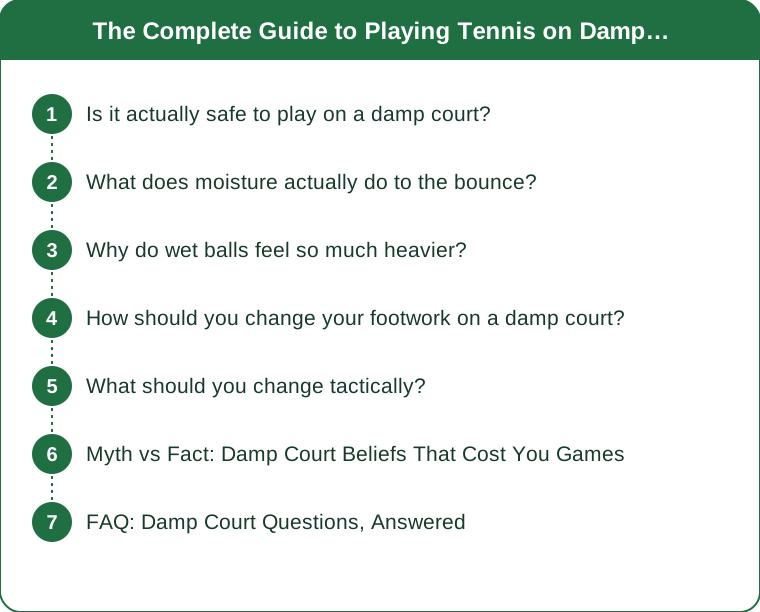
Is it actually safe to play on a damp court?
There is a real line, and it is not the same as ‘wet’ versus ‘dry’. A uniformly damp acrylic hard court is one of the more forgiving surfaces you will play on. A hard court with a film of water on top is one of the most dangerous, because the water separates your outsole from the texture entirely and you get no warning before the foot goes.
The field test takes four seconds. Drag the side of your shoe across the surface with moderate pressure and look at what you leave behind. If the mark darkens and stays matte, the moisture is in the texture and you have grip. If water rises into the print or the mark shines, the moisture is sitting on top and you do not. Repeat it in three places - baseline centre, both service boxes, and especially the shaded end. Courts do not dry evenly, and the corner behind a fence line or under a tree can stay slick for two hours after the rest is fine.
Surface matters as much as the water. Acrylic hard courts hold a slick film and are the riskiest when wet, because the sand-loaded paint is designed to grip a dry shoe. Clay actually plays better slightly damp than bone-dry, which is why crews water it - the risk there is the opposite, a court so wet it becomes greasy on top of firm subsoil. Artificial grass and carpet shed water fastest but get genuinely treacherous in the transition zone where wet meets dry, because your grip changes mid-stride.
The injury pattern is worth naming plainly. Wet-court falls are not usually the dramatic forward skid; they are the lateral slip during a change of direction, where the outside foot keeps travelling and the knee stays put. That is an ankle or a knee, not a scraped palm. If you are going to be conservative anywhere, be conservative about wide balls in the first fifteen minutes.
And one honest caveat: if you are managing an existing ankle, knee or Achilles issue, a damp court is not the day to test it. General guidance only - if something is already painful, that is a conversation for a physio, not a court-side judgement call.
What does moisture actually do to the bounce?
Two separate things happen, and players usually blame the wrong one.
The first is friction. A damp surface has a higher coefficient of friction against the felt of the ball at the moment of impact. That sounds backwards - wet should be slippery - but the ball is not sliding across the court the way your shoe does. It is compressing into it for a few thousandths of a second, and the damp felt-on-damp-paint contact grabs. The ball loses more forward speed in the bounce than it would on dry paint.
The second is energy return. Water in the surface texture absorbs impact energy that a dry court would give back. Combine them and you get the signature damp-court bounce: lower and slower, arriving later than your feet expect. In practice, on a medium-pace hard court, expect the ball to come up somewhere around 10 to 20 percent lower than the same shot the previous afternoon. That is the difference between a comfortable hip-height forehand and a ball you are digging out at the knee.
This hits shot types very unevenly, which is why the game feels strange rather than just slow:
- Topspin loses the most. Your heavy forehand relies on the bounce converting spin into an upward kick. Damp paint eats exactly that. Your best shot becomes a mid-height sitter.
- Slice gains. The backspin that normally bites and sits now skids low and long, and it stays under the strike zone. On a damp morning, slice is the most improved shot in your bag.
- Flat drives change least, which is why flat hitters often do not notice the court is damp until they try to defend.
- The kick serve is the biggest loser of all. Its entire value is the vertical jump off the surface, and that is exactly the energy the court is now absorbing.
The practical consequence: the player who wins on a damp morning is usually not the better player. It is the one who noticed first.
Why do wet balls feel so much heavier?
Because they are. This is not perception.
Tennis felt is a wicking material, and a ball rolled through dew across a full court picks up measurable water. A new ball sits around 58 grams. A saturated ball can gain several grams, which is a meaningful percentage of its total mass, and every gram of it is mass you are decelerating and re-accelerating with your shoulder.
Worse, the water does not just add weight. It kills the ball’s aerodynamics. Wet felt mats down and stops gripping air, so the ball spins the same but the spin does less. Your topspin arcs less, your slice floats more, and the ball flies flatter and further than the swing you made suggests. Players compensate by swinging harder, which is precisely the wrong response and is the reason a wet-court hitting session leaves your shoulder and elbow sorer than a dry one twice as long.
What to do about it, in order of how much it helps:
- Bring more balls than you need and rotate them out early. Three cans for a two-hour damp session is not excessive. Retire a ball the moment it darkens.
- Keep the spares off the ground. A ball tube, a bag pocket, the net post - anywhere but sitting on the baseline soaking up the court between points.
- Do not stuff wet balls in a pocket. It is convenient and it ruins them for the rest of the session.
- Never trap a wet ball against the court with your racquet face to pick it up. You are pressing water into the felt, and you are pushing your strings through grit.
- Dry the balls, not just the court. A towel wipe between points removes surface water and buys you several more points of normal behaviour.
And afterwards: let them dry loose and at room temperature. Wet balls sealed in a bag overnight come out dead, heavy and slightly sour, and no amount of pressurised storage brings them back.

How should you change your footwork on a damp court?
Assume you have grip forwards and no grip sideways. That single mental model fixes most of it.
The reason is mechanical. Your outsole pattern is designed to shed water along its length as you push off, so a straight-line acceleration or stop still works surprisingly well. A lateral load presses the whole outer edge down at once with nowhere for the water to go, and that is the moment the foot leaves.
So:
Take smaller, more frequent steps. The long recovery crossover that covers ground efficiently on a dry court is the exact movement that fails. Three short steps to the same place is slower on paper and faster in practice, because you never lose contact.
Split step lower and land softer. A high, hard split step is a landing you have to absorb through a foot that may or may not hold. Lower centre of gravity, quieter landing.
Do not slide unless you play on clay and mean it. Sliding on damp acrylic is not a hard-court slide; there is no controlled friction underneath it, and it ends when the shoe finds a dry patch. That sudden re-grip mid-slide is the classic ankle roll.
Change direction on two feet where you can. Planting one foot and cutting is the highest-risk movement available to you. Gathering, then pushing, costs a fraction of a second and removes almost all the danger.
Check and clean your outsoles every few games. Damp courts lift dust and grit that packs into the tread and turns a textured sole into a smooth one. Two scrapes against the net post edge is enough.
One equipment note: shoes with a herringbone or full-coverage tread shed water far better than the smooth-panelled modern hard-court soles. If you play regular early mornings in late summer, that is a genuinely worthwhile thing to look at in your next pair.
What should you change tactically?
Damp conditions do not just slow the court. They change which shots are profitable, and adjusting the pattern is worth more than adjusting the technique.
Hit higher over the net - about two feet more than usual. With the ball flying flatter off wet felt and dying on the bounce, your normal net clearance produces balls that land short and sit up. More arc restores both depth and margin, and depth is what stops your opponent stepping in.
Lean on the slice, hard. It is the one shot the conditions improve. A low skidding slice on a damp court is close to unplayable for anyone whose main weapon is a topspin drive, because they cannot get under it. On a wet morning, a slice-heavy backhand player is genuinely dangerous.
Take pace off the first serve and put spin on nothing. The kick serve has lost its kick. A flat or slice serve to the body is the highest-value serve available, because the surface is already doing the work of keeping the return low and awkward.
Come in more than you normally would - but earlier. Passing shots need bounce to dip. Without it, they fly flat and long. The catch is the approach: you cannot sprint-and-stop, so start moving forward a shot earlier than feels natural and arrive under control.
Drop shots become excellent and then terrible. They stop dead on damp paint, which is beautiful. But your opponent also cannot accelerate forward safely, so it is a shot that wins points cheaply and, if overused, gets someone hurt. Use it sparingly and with people you know.
And accept the first four games are diagnostic. Instead of grinding your usual patterns into a surface that will not cooperate, use them to find out what is actually working today. The player who adapts by 2-2 usually wins the set.
Myth vs Fact: Damp Court Beliefs That Cost You Games
Myth: If the court looks dry, it is dry. Fact: Dew evaporates from the top down and the shaded thirds of a court can be meaningfully damper than the sunlit ones for well over an hour after the surface looks uniform. The shoe-drag test, in three places, takes four seconds and is worth more than a glance.
Myth: A towel-dry pass over the court fixes it. Fact: On a hard court, towelling removes standing water but leaves the texture saturated, and it is the texture that controls bounce. You have made it safer. You have not made it dry, and the ball will still sit low.
Myth: Wet balls play slower, so you should swing harder. Fact: This is the single most common damp-court mistake and the reason for post-session shoulder pain. Wet felt flies flatter and further - swinging harder adds length you cannot control and load your shoulder cannot afford. Swing the same and aim higher.
Myth: Grip tape does not matter when it is only humidity, not rain. Fact: Your grip absorbs sweat and airborne moisture at the same time, and a saturated overgrip is slippery in a way that leads to gripping tighter, which is a direct route to tennis elbow. Late-summer mornings burn through overgrips faster than mid-July afternoons.
Myth: Playing on damp clay ruins the court. Fact: Damp clay is the intended condition - crews water it deliberately. What ruins clay is playing on it when water is pooling, because footprints set as permanent divots. The rule for clay is puddles, not dampness.
Myth: You should just wait until it dries. Fact: Sometimes, sure. But in late August a dewy court at 7am is often still slightly damp at 9am, and ‘waiting it out’ means never playing early. Reading the surface and adjusting is a skill, and it is a transferable one.
FAQ: Damp Court Questions, Answered
How long does dew take to burn off a hard court?
On a clear late-August morning, typically 60 to 120 minutes after direct sun reaches the surface - but shaded sections lag badly and can stay damp until mid-morning. The variable that matters most is not temperature, it is direct sunlight on that specific patch of court. A court that is half shaded by a fence line or a treeline will effectively be two different surfaces for the first hour, which is worse than a uniformly damp one.
Are wet-court conditions worse for tennis elbow?
Yes, on two counts, and they compound. Heavier balls transmit more shock through the strings into the forearm, and a damp grip makes you squeeze harder to keep the racquet stable. Tight grip plus higher impact load is the exact recipe. If you play damp mornings regularly, a fresh overgrip and dropping string tension a couple of pounds are both cheap insurance.
Should I lower my string tension for damp play?
It genuinely helps, and two to three pounds is enough to notice. Lower tension gives you more depth from a shorter, more controlled swing, which is precisely the swing damp conditions reward - and the softer string bed takes some of the extra shock from the heavier ball. Natural gut is the exception: it hates moisture and will fray, so if you have a gut or gut-hybrid setup, keep it for dry days.
This article is general information, not medical advice. If you have persistent joint pain or you are returning from an injury, talk to a physiotherapist or a sports medicine professional before deciding what conditions are appropriate for you.
TL;DR:
- Test before you play: drag a shoe. Darkens and stays matte, you have grip. Water rises or it shines, you do not.
- The bounce goes lower and slower - topspin and kick serves lose the most, slice gains the most.
- Wet balls gain real mass and fly flatter. Rotate them out early, keep spares off the ground, and do not swing harder to compensate.
- Footwork rule: grip forwards, no grip sideways. Small steps, low split, no sliding, change direction on two feet.
- Tactically: two feet more net clearance, more slice, flat or body serves, come in earlier and under control.
Damp courts are not a lesser version of tennis. They are a different surface that happens to be in the same place, and the players who treat them that way stop losing the opening four games to something that was never about their form.
See It in Motion
Seen here: UPF 50+ Pleated Running Skort with 26” Leggings & Pockets — shop similar styles on bubblelime.com
Keep Reading
This article is for general informational purposes only and is not medical advice. It is not a substitute for professional diagnosis or treatment. Always consult a qualified healthcare provider about your individual situation, especially before making significant changes to your diet or exercise routine.