Why You Lose the First Game of Almost Every Match, and the Warm-Up That Fixes It
Quick Answer: Losing the first game usually is not nerves and it is not your technique. It is that the five-minute knock-up on court warms your strokes but not your legs, your eyes, or your decision-making, so you start the match with slower first steps, later contact points, and no reliable sense of depth. The fix is a ten to fifteen minute off-court warm-up before you ever hit a ball, plus a deliberately conservative game plan for the first three or four games while your calibration catches up.
You know the pattern. You lose the first game, sometimes the first two, and then somewhere in the middle of the set you start playing the tennis you actually own. By then you are down a break and chasing.
The encouraging part is that this is one of the most fixable problems in recreational tennis, because almost nobody addresses it.

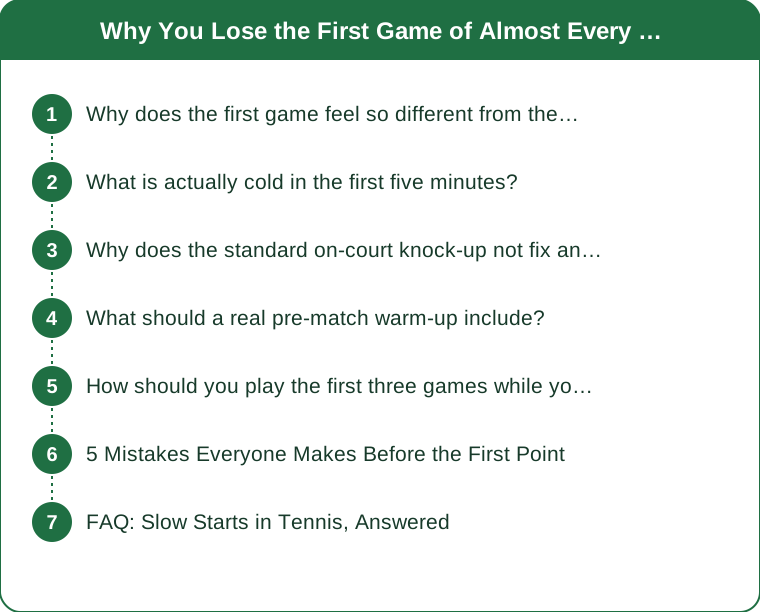
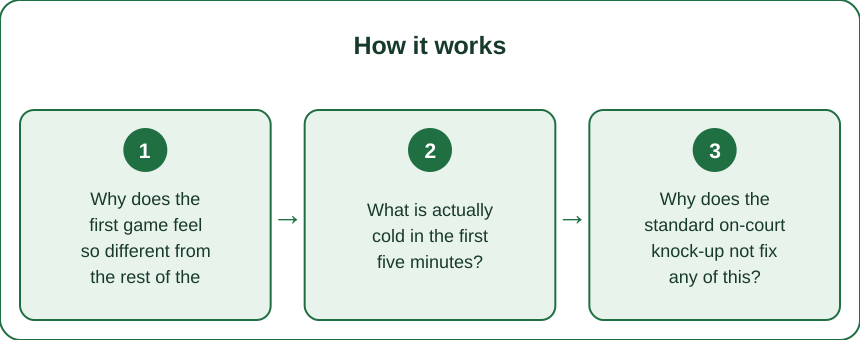
Why does the first game feel so different from the rest of the match?
Because almost nothing about your body is at match readiness yet. Muscle temperature rises with activity, and warmer muscle contracts and relaxes faster. In the first few minutes of play you are producing force with tissue that is still closer to resting temperature than to working temperature, which shows up as a first step that arrives late rather than as anything you would recognise as weakness.
Your heart rate and breathing are still catching up. Cardiovascular systems take several minutes of sustained work to shift into a steady state that supports repeated sprint-and-recover efforts. The first game is often the only part of the match played while that adjustment is still happening, which is why the third or fourth point of a long first game can feel disproportionately hard.
Your eyes have not calibrated to the ball, the light, or the court. Judging the flight of a ball is a learned, context-specific skill, and the context changes every time you play: different court surface, different light angle, different opponent’s pace and spin. The first several balls you see from a new opponent are effectively data collection, and you tend to hit them either early or late.
Your sense of court dimension resets between sessions. Depth control on groundstrokes depends on an internal model of how hard you need to hit to land a ball three feet inside the baseline on this court, in this air, with these balls. New balls fly differently from worn ones. Humid air behaves differently from dry air. That model needs a few dozen repetitions to re-form.
And your decisions are slower before your pattern recognition wakes up. Experienced players read the shape of a point early - where the opponent is recovering, whether the ball is going to sit up. That reading is fast once it is running, but it does not switch on instantly.
All of that lands on the first game specifically. By game four or five, your muscle temperature is up, your breathing has settled, and you have seen forty balls from this opponent. Nothing about you improved. You simply became ready, several games after the scoreboard started counting.
What is actually cold in the first five minutes?
Your hips and glutes, which drive the first step. Tennis movement is dominated by short lateral accelerations, and those come from the hip musculature working through a wide range. If you arrived from a car seat or a desk chair, those muscles have been in a shortened position for an hour or more, and the first few wide balls will be the ones you arrive at half a step late.
Your calves and Achilles tendons, which handle the split step. The split step is a small hop that reloads your legs on every shot, and it relies on elastic tissue that is stiffer when cold. Cold tendons return less energy, which is exactly why early-match split steps feel heavy and why calf strains cluster in the first few games of recreational matches.
Your shoulder, in the specific ranges a serve demands. The serve takes the shoulder into deep external rotation at high speed. A shoulder that has done nothing but hold a racket bag is not prepared for that, which is why so many first-service games either lose pace or lose the toss entirely as players unconsciously shorten the motion to protect themselves.
Your forearm and wrist, which set the racket face. Grip pressure tends to be higher when you are cold and tense, and a tighter grip reduces the fine control that puts the racket face at the right angle. That is one mechanism behind the early-match balls that fly long for no obvious reason.
Your thoracic spine, which lets you rotate. Rotation through the upper back is what allows a full unit turn on the backhand and a proper shoulder-over-shoulder serve. When it is stiff, you compensate by arming the ball, and arming the ball is inconsistent by nature.
And your nervous system, which is the piece nobody warms up. Rate of force development - how quickly you can produce force, not how much - improves measurably after a few minutes of progressive intensity work. That single quality is most of what separates your first game from your fifth.
Why does the standard on-court knock-up not fix any of this?
Because it is a rally, not a warm-up. The traditional five minutes of mid-pace crosscourt hitting from a comfortable position warms your arm and gives you a look at the ball. It does not involve sprinting, changing direction, reaching wide, or recovering, which is what the match will be made of.
It is also usually too short. Guidance for warm-ups across sports generally lands in the ten to twenty minute range for a full progressive preparation. The on-court knock-up in recreational tennis is often under five minutes, and half of that is spent picking up balls.
You do not practise the movements you will actually make. Warm-ups transfer best when they resemble the task. Standing still and hitting forehands prepares you for standing still and hitting forehands, which is not a shot that occurs in a match after the first ball of a rally.
Serves are frequently the last thing warmed and the first thing tested. Most knock-ups end with two or three serves each, and then someone serves for real. That is a near-maximal shoulder movement performed cold, and it is both a performance problem and the most common way recreational players hurt themselves.
Court time pressure makes it worse. On a public court with a queue or a booked hour, the temptation is to start the match immediately and use the first set as the warm-up. That is a choice, but it should be a deliberate one rather than something you discover on the scoreboard.
And the opponent’s warm-up is not your warm-up. Whoever arrives already warm wins the first two games disproportionately often, and in social tennis that is frequently just the person who happened to walk from the car park faster or who played the hour before. It is an entirely avoidable head start to give away.

What should a real pre-match warm-up include?
Start with five minutes of easy continuous movement. Jogging the perimeter of the court, skipping, or brisk walking with arm swings. The goal is a mild rise in body temperature and a light sweat - if you are not slightly warm, nothing that follows works as well.
Then do dynamic mobility through the ranges you will use. Leg swings forwards and sideways, walking lunges with a torso rotation, hip circles, and thoracic rotations. Roughly eight to ten repetitions each, moving through range rather than holding. Save long static stretching for after you play - held stretches immediately before explosive activity can slightly blunt power output.
Add progressive footwork. Two or three sets of side shuffles across the service box, a few carioca runs, and four to six short accelerations building from about 60 percent to near full speed. This is the piece that most directly changes your first step in game one, and it takes about three minutes.
Do shadow swings before you hit. Ten forehands, ten backhands, and ten full service motions without a ball, gradually increasing range and speed. Your shoulder gets to rehearse the serve at a controlled intensity rather than discovering it at full speed on the first point.
Then use the on-court knock-up properly. Start short in the service boxes for a couple of minutes, then move back and lengthen out. Deliberately hit some balls on the move rather than rallying from a fixed spot, and take a few returns from your partner’s practice serves so the first return you see is not in a live game.
Finish with at least eight to ten real serves per side. Build them: two at half pace, four at three-quarters, then a few at full intensity with a target. If the format allows only a couple of serves, take the rest before you go on court by shadowing plus serving into a fence or a wall.
Total time: about twelve to fifteen minutes. If your match starts at ten, you are moving at quarter to. This is general information rather than medical advice - if you are managing an injury, a clinician or coach should shape the specifics.
How should you play the first three games while you are still calibrating?
Give yourself more margin than usual. Aim two to three feet inside the lines and one to two feet higher over the net than your normal target. Your depth model is not calibrated yet, and errors in the first game cost the same as errors in the tenth while telling you nothing useful.
Hit crosscourt by default. The net is lower in the middle and the court is longer diagonally, so crosscourt is the higher-percentage direction. Save the line change for once you can feel your depth.
Serve at about 80 percent for the first service game. A first serve landed at three-quarter pace beats a missed one at full pace by a wide margin, and it lets your shoulder finish warming inside live points rather than gambling on a cold arm.
Take a little more time between points. You are allowed to walk back, adjust strings, and breathe. Rushing while cold produces exactly the flat, tentative points that lose early games, and the extra fifteen seconds is time your body is still using.
Collect information deliberately. In the first two games, notice which side your opponent hits harder from, whether their second serve sits up, and whether they move forward willingly. That information wins games five through nine, and gathering it is a genuinely productive use of a game you are more likely to lose anyway.
Do not chase the break back immediately. If you drop the first game, the impulse is to press harder in the second, which usually means bigger targets and more errors while still cold. Playing three solid conservative games and holding steady until your calibration arrives is how the set stays close.
And accept that a slow start is a warm-up problem, not a character flaw. Players who conclude they are mentally weak in the first game tend to add tension, and tension makes the physical problem worse. The scoreboard in game one is measuring your preparation, not your temperament.
5 Mistakes Everyone Makes Before the First Point
Mistake 1: Arriving with three minutes to spare. Preparation that has to fit into the walk from the car is not preparation. Arriving fifteen minutes early is a bigger performance upgrade than any racket you could buy, and it costs nothing.
Mistake 2: Static stretching as the entire warm-up. Long holds of a hamstring stretch on a cold muscle do very little to prepare you for explosive movement and can modestly reduce power output if done immediately before play. Dynamic movement first, held stretches afterwards.
Mistake 3: Serving hard on the second serve you have ever hit that day. The serve is the highest-load, highest-speed movement in the sport, and rushing it cold is how recreational players end up with shoulder problems that last months. Build up. Always.
Mistake 4: Treating the knock-up as a chance to look good. Blasting winners past your opponent during the warm-up warms nothing except your ego. Short, then long, then on the move, then serves and returns. In that order.
Mistake 5: Not warming up at all in doubles because you think you move less. Doubles has shorter points but sharper accelerations, more reaching volleys, and more overheads - all of which are movements at the outer edge of your range. Less running does not mean less demand on cold tissue.
The one that surprises even regular players is the fourth. People assume the knock-up is warm-up time and then use it in a way that guarantees it is not, which is why the first game keeps going the same way season after season.
FAQ: Slow Starts in Tennis, Answered
Why do I always lose the first game of tennis?
Most often because you start the match physically and visually unprepared. Muscle temperature, heart rate, split-step responsiveness, depth judgement, and pattern recognition all take several minutes of real activity to reach match level, and the standard five-minute knock-up develops almost none of them.
How long should a tennis warm-up be?
Aim for roughly twelve to fifteen minutes total: about five minutes of easy continuous movement, five of dynamic mobility and footwork including a few accelerations, then shadow swings before the on-court knock-up and eight to ten build-up serves.
Should I stretch before playing tennis?
Use dynamic movement before you play - leg swings, lunges with rotation, thoracic rotations - and save longer static holds for afterwards. Long static stretches immediately before explosive activity can slightly reduce power without reducing injury risk in a meaningful way.
Is a slow start nerves or fitness?
Usually neither in isolation. Nerves add tension on top of a body that genuinely is not ready, so improving the warm-up often reduces the apparent nerves too, because the first few balls start landing where you intended.
What should I do if there is no time to warm up?
Warm up off court before you get there - a brisk five-minute walk, leg swings, arm circles, and shadow swings can be done beside the court or in a car park. Then play the first three games with extra margin and serve at around 80 percent.
TL;DR:
- The first game is lost to preparation, not talent: cold hips and calves, an unsettled heart rate, and eyes that have not calibrated to the ball or the court.
- The standard five-minute knock-up warms your arm and nothing else - no sprinting, no direction changes, no returns, and almost no serves.
- Build a twelve to fifteen minute routine: easy movement, dynamic mobility, short accelerations, shadow swings, then a structured knock-up and eight to ten build-up serves.
- Play the first three games with extra margin, mostly crosscourt, serving at around 80 percent, and use them to collect information about your opponent.
- Never serve near-maximally cold - it is the single most common way recreational players injure a shoulder.
You are not a slow starter. You are an unwarmed one, and that is a scheduling problem with a fifteen-minute solution.
See It in Motion
Seen here: UPF 50+ Pleated Running Skort with 26” Leggings & Pockets — shop similar styles on bubblelime.com
Keep Reading
This article is for general informational purposes only and is not medical advice. It is not a substitute for professional diagnosis or treatment. Always consult a qualified healthcare provider about your individual situation, especially before making significant changes to your diet or exercise routine.