Why Your Tennis Game Falls Apart in the First Cold Week
Quick Answer: Your game drops in the first cold week because the ball loses bounce and pace, the strings go stiffer, your hands lose fine control before your legs lose power, and your usual eight-minute warm-up is now about half of what you need. Add fifteen minutes of warm-up, drop your string tension by two to four pounds, and expect to hit two to three feet deeper than feels correct.
It happens on the same court, against the same person, with the same racquet.
Late August is fine. Then one morning the air is fifteen degrees cooler than it was a week ago, and your forehand — the shot you never worry about — starts landing short by two feet. Every single time.
Nothing about your technique changed overnight. The physics did.

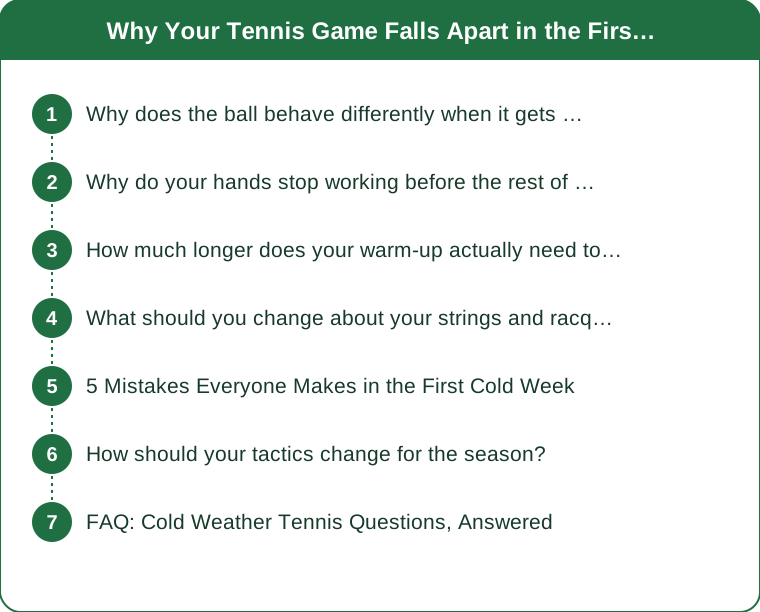
Why does the ball behave differently when it gets cold?
A tennis ball is a pressurised rubber shell. The pressure inside it, and the elasticity of the rubber around it, both depend on temperature.
Cold air reduces the internal pressure of the ball. Cold rubber is stiffer and returns less of the energy it absorbs on impact. The result is a ball that comes off the court lower, slower, and with noticeably less life than the same can of balls delivered in July.
The practical numbers matter more than the physics. Between a warm summer afternoon and a cool autumn morning, most club players find the ball bounces two to four inches lower and arrives with meaningfully less pace. That does not sound like much until you realise your entire contact-point habit is calibrated to a specific bounce height.
You have spent months meeting the ball at roughly waist height on a normal rally shot. Now it arrives at upper-thigh height. Your swing path is built for the higher contact, so you either brush up on a ball that has already dropped below your strings — sending it into the net — or you adjust late and mistime it.
There is a second effect people miss entirely. Cold air is denser. Denser air produces more drag, which slows the ball further through the flight, and it also produces more aerodynamic effect on spin. Your heavy topspin forehand dips harder than it did in August. That is why the shot that landed on the baseline in summer now lands three feet inside it.
Two changes, both physical, both pushing your ball shorter. It compounds.
The fix is simple to say and uncomfortable to execute: aim deeper than feels safe. Pick a target two to three feet beyond where you would normally aim and hit there for an entire set. It will feel reckless for about fifteen minutes and correct after that.
Why do your hands stop working before the rest of you?
This is the part that surprises people. You warm up, your legs feel fine, your breathing is fine — and your touch is gone.
Peripheral circulation is the reason. In cool conditions the body preferentially protects core temperature by reducing blood flow to the extremities. Hands and fingers cool faster than any other working part of you, and they cool before you consciously feel cold.
Fine motor control degrades with hand temperature well before grip strength does. That means the shots that go first are the touch shots: the drop volley, the slice that is supposed to stay low, the second serve where you rely on feel rather than force. Your flat drive survives long after your touch has left.
A few things actually help:
Keep a warm-up layer on your forearms, not just your torso. A long-sleeve base layer under a short-sleeve top covers the forearm musculature that controls your fingers. This does more for touch than a heavier jacket does.
Use your pockets between points. Twenty seconds of hands-in-pockets between points is enough to slow the cooling curve substantially. It looks lazy. It works.
Carry a second overgrip. Cool air is often drier air, and a grip that felt tacky in humidity can feel slick and glassy in the cold. If the racquet is rotating slightly in your hand on contact, it is not your grip pressure — it is the grip surface.
Do not squeeze harder to compensate. This is the instinctive response and it is counterproductive. Higher baseline grip tension reduces the fine adjustments your wrist makes at contact, and it fatigues your forearm faster. If your touch is off, lengthen your warm-up rather than tightening your hand.
One useful test: if you cannot comfortably do ten fast, full-range finger spreads before you serve, your hands are not ready regardless of how your legs feel.
How much longer does your warm-up actually need to be?
Roughly double. That is the honest answer, and it is the single highest-value change on this list.
The standard club warm-up — five minutes of mini-tennis, a few baseline rallies, four serves — is barely adequate at 25°C. At 12°C it is not close.
Muscle and tendon become measurably stiffer at lower temperatures. Stiffer tissue transmits force differently, tolerates rapid stretch less well, and takes longer to reach the temperature at which it moves efficiently. Two structures matter most for tennis players: the shoulder in the serve, and the calf and Achilles in the first hard change of direction.
A practical cold-weather warm-up, about fifteen minutes:
- 3 minutes of continuous movement before you touch a ball. Jog the perimeter, side shuffles both directions, a few gentle skips. The aim is raising core temperature, not stretching.
- 4 minutes of mini-tennis, gradually opening from service box to service line. Do not rush this — it is where your hands come back online.
- 4 minutes of baseline rallying at 70 per cent, deliberately hitting cross-court only, deliberately hitting deep.
- 2 minutes of movement work — a handful of split-step-and-push starts, and two or three easy sprints to a wide ball.
- 2+ minutes of serving, starting at about half pace and building. Never start with a full-pace first serve in the cold.
If you play a fixed-length booking and cannot extend it, warm up before you get on court. Ten minutes of brisk walking and arm circles in the car park is not glamorous, but it converts the first three games from a write-off into a competitive stretch.
The most common injuries in the first cool weeks of the season — calf strains and shoulder irritation — cluster almost entirely in the first fifteen minutes of play. That is not a coincidence.

What should you change about your strings and racquet?
String behaviour is temperature-dependent, and this is where a small adjustment produces a disproportionate improvement.
Polyester strings stiffen substantially in the cold. If you play with a full poly bed, the string bed you are hitting on in October is meaningfully firmer than the one you strung in August, even if it is the same string at the same stated tension. Firmer bed means less dwell time, less spin generation, and less power — all pushing your ball shorter, on top of everything the ball is already doing.
Natural gut and multifilament are far less affected. They lose some liveliness but nowhere near as much.
Sensible responses, in order of how much they help:
Drop tension by two to four pounds. This is the single best cold-weather adjustment for a poly player, and it costs one restring. It restores dwell time and gives back much of the depth you lost.
Consider a softer setup for the cool months. A poly-multifilament hybrid, or moving from a stiff poly to a softer one, gives you a more forgiving string bed exactly when your arm has the least tolerance for shock.
Restring more often than you think, not less. Cold does not make strings last longer. Poly loses tension continuously from the moment it goes in the frame, and a dead poly bed in cold conditions is the worst combination available for both performance and elbow comfort.
Keep your racquets out of the boot of the car. A frame that has been sitting at 4°C overnight has a string bed that behaves badly for the first twenty minutes. A thermal bag is a real thing that does a real job.
One thing not to change: do not switch to a heavier frame because the ball feels dead. Heavier frames in cold conditions increase shock transmitted to a stiffer arm. Adjust the strings, not the racquet.
5 Mistakes Everyone Makes in the First Cold Week
These show up on club courts every single autumn, in the same order.
1. Serving at full pace in the first two games. The shoulder is the slowest joint to warm and the serve is the most explosive motion in the sport. Almost every early-season shoulder complaint traces back to this. Start at 60 per cent and build over three or four service games.
2. Blaming technique for depth loss. The ball is landing short because of temperature, air density, and string stiffness. Rebuilding your forehand in October to solve a physics problem creates a genuine technique problem by November.
3. Over-layering the torso and ignoring the arms. A thick jacket over bare forearms keeps your core comfortable while your hands and touch continue to disappear. Layer the limbs.
4. Skipping the cool-down because it is cold. Stiff tissue that has just done a hard hour benefits more from five minutes of easy movement, not less. Walking straight to a cold car is how a tight calf becomes a strained one.
5. Using summer’s tactical plan. In cool conditions the ball sits up less, so aggressive high-margin topspin is less effective and slice becomes disproportionately strong — a low slice in cold air stays genuinely low. Your opponent’s ability to get under it drops sharply. If you have a slice backhand you have neglected all summer, autumn is when it becomes a weapon.
The third one surprises even long-time players, because it feels like the opposite of a problem — you are warm, so you assume you are ready.
How should your tactics change for the season?
The conditions do not just make you worse. They redistribute who has an advantage, and you can play that.
Depth beats angle. Cold, dense air punishes the sharp angle — the ball slows in flight and the angle you have opened up gives your opponent time to run it down. Deep, heavy cross-court balls are more effective than they were in summer because the low bounce makes them genuinely awkward to attack.
Slice becomes a primary shot, not a defensive one. A well-struck slice in cool conditions can stay under knee height. Players who have spent all summer hitting topspin at hip height find this genuinely uncomfortable.
Net play improves. The ball comes through lower and slower, which means passing shots have less margin and lobs are harder to hit deep enough. If you are a competent volleyer, cold weather is your season.
The first serve percentage matters more than the first serve speed. Cold balls come off the court slower, so a big flat serve is less rewarding than it was; a high-percentage first serve that forces a weak return is worth more, and it costs your shoulder much less.
Points get longer, so manage them. Expect longer rallies and plan your fitness accordingly. If you fade at the ninth game in summer, you will fade at the seventh now.
One more practical thing: balls die faster in the cold. A can that would give you two good sets in August will feel dead after one. Open a fresh can more often than you would in summer — it is the cheapest performance improvement in the sport.
FAQ: Cold Weather Tennis Questions, Answered
Is it bad for your racquet to play in cold weather?
Modern graphite frames are fine in normal autumn temperatures. The real risk is thermal shock and a stiff string bed — a frame stored in a freezing car and then used immediately at full pace is the situation to avoid. Bring your racquets indoors overnight and give them a few minutes of easy hitting before you swing hard.
Should I switch to pressureless balls in the cold?
They are a reasonable choice for practice and drilling, since they do not lose internal pressure and stay consistent across the session. They feel heavier and play differently from match balls though, so if you are preparing for competition, use fresh pressurised balls and simply open new cans more often.
At what temperature should I stop playing outdoors?
There is no universal cutoff, but below roughly 5°C most players find that hand function and injury risk make it a poor use of court time — particularly for anyone with a history of calf, Achilles, or shoulder problems. If you do play, extend the warm-up further, drop the intensity, and treat it as movement rather than training. If you have any cardiac or respiratory condition, cold air is a genuine trigger and is worth discussing with a professional first.
This is general information, not medical advice.
TL;DR:
- The ball bounces two to four inches lower and travels slower in cold, denser air — aim two to three feet deeper than feels correct
- Your hands lose fine motor control before your legs lose power, so layer your forearms and use your pockets between points
- Double your warm-up to about fifteen minutes, and never open with a full-pace serve
- Drop poly string tension by two to four pounds and keep the frames out of the cold car
- Tactically, slice and net play get stronger while sharp angles get weaker
None of this is a decline in your tennis. It is a different set of conditions asking for a different set of settings, and the players who adjust in week one spend the rest of the season beating the players who spend it wondering what happened to their forehand.
See It in Motion
Seen here: UPF 50+ Adjustable A-Line Running Skort with Pockets — shop it on bubblelime.com
Keep Reading
This article is for general informational purposes only and is not medical advice. It is not a substitute for professional diagnosis or treatment. Always consult a qualified healthcare provider about your individual situation, especially before making significant changes to your diet or exercise routine.