Does Pickleball Actually Cause Less Elbow Strain Than Tennis? The Honest Comparison
Quick Answer: Partly true. Pickleball’s smaller paddle, shorter swing, and slower ball genuinely reduce per-shot load. But it also delivers more shots per hour, transmits more vibration through a rigid paddle face, and attracts players with less racket-sport conditioning. Volume and technique matter more than sport choice.
“It’s easier on the joints” is the line that sells pickleball to everyone leaving tennis with a sore arm.
Half of that is mechanically accurate. The other half is a reputation that has outrun the physics.

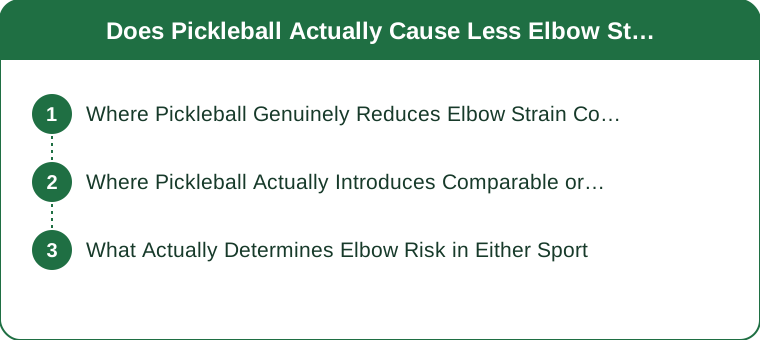
Where does pickleball genuinely reduce elbow strain?
Shorter lever, shorter swing. A pickleball paddle is smaller and the stroke mechanics are more compact, which reduces lever-arm stress on the elbow compared with a full tennis racket swing.
Lower ball speed. Slower ball speed means less impact force transmitted through the paddle into the arm on each contact than a fast groundstroke or serve.
Less explosive movement. A smaller court with lower movement demands reduces some of the whole-body force generation that translates into arm strain during explosive tennis strokes.
These are real mechanical differences, not marketing. On a per-shot basis, pickleball asks less of the elbow. The problem is that elbows don’t get injured per shot.
What does the “gentler” reputation leave out?
- Repetition volume. Shorter points and faster pace often mean a comparable or higher total shot count per session, even though each shot is less forceful. Overuse injuries are a volume story.
- Vibration transmission. A rigid paddle face doesn’t absorb shock the way a strung racket does. Off-center or mistimed hits send more vibration straight into the forearm.
- Kitchen exchanges. Fast net play creates a rapid, repetitive wrist-and-elbow loading pattern with none of the rally-pacing variety tennis offers.
- Player population. Pickleball attracts a lot of people new to racket sports, without years of accumulated sport-specific conditioning — a factor entirely independent of which sport is mechanically gentler.
- Less formal instruction. Self-taught entry is the norm, so technique errors like over-gripping or leading with the elbow go uncorrected longer.

Myth vs Fact
Myth: Switching from tennis to pickleball will fix your tennis elbow. Fact: It changes the loading pattern, not the mechanics that caused it. If your grip is tight and your technique is wrist-led, both sports will find the same tendon. Tennis elbow was never really about tennis.
Myth: Slower ball equals safer arm. Fact: Per shot, yes. Per session, the higher shot count frequently cancels the advantage out.
Myth: Paddle choice is just personal preference. Fact: Paddle weight, grip circumference, and core construction meaningfully change vibration transmission. It’s the closest thing to a free reduction in load available.
Myth: Pickleball injuries are all ankles and knees. Fact: Upper-limb overuse complaints are common enough to have earned their own nickname. The lower-body injuries just make better stories.
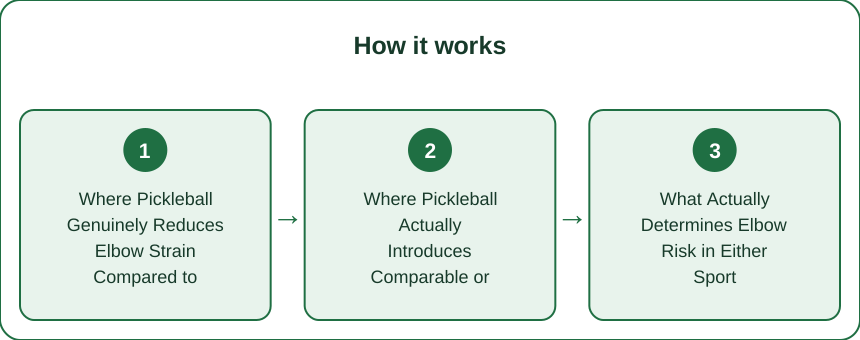
What actually determines your elbow risk?
Total volume and recovery. Hours played per week and rest between sessions matter far more for overuse risk than which of the two sports you picked.
Equipment fit. Correct grip size and appropriate paddle or racket weight for your hand size and strength reduce strain in either sport. Get it checked rather than assuming defaults suit you.
Technique quality. A relaxed grip that firms only at contact, and power generated from the body rather than the wrist, beats sport selection as a risk reducer every time.
Conditioning and warmup. Forearm and grip strength work plus a genuine warmup is sport-agnostic protection. Five minutes before play is not a rounding error.
Individual history. Prior elbow injury and individual joint structure matter as much as anything on this list. Prevention basics apply identically in both sports.
When to see a professional: elbow pain lasting more than two or three weeks, pain that disturbs sleep, weakness gripping everyday objects, or any numbness or tingling into the hand should be assessed by a physician or physical therapist. Numbness in particular can signal nerve involvement rather than simple tendinopathy, and the treatment paths differ. Playing through it with unchanged mechanics is the most reliable way to turn a short problem into a long one.
FAQ
Is “pickleball elbow” a different condition from tennis elbow?
Clinically they’re the same lateral epicondyle tendinopathy. The loading pattern that produces it differs — more wrist-driven, higher repetition, more vibration — which is why our side-by-side comparison focuses on mechanism rather than diagnosis.
Should I switch paddles if my elbow hurts?
It’s a reasonable early step. A slightly heavier paddle with a softer core and a correctly sized grip transmits less shock. Just don’t expect equipment alone to fix a technique or volume problem.
How much pickleball is too much?
There’s no universal number — it depends on conditioning, technique, and history. The practical signal is soreness that hasn’t cleared before your next session. When that starts stacking, reduce frequency before it becomes a months-long issue.
TL;DR:
- Real advantages: smaller paddle and swing, lower ball speed, less explosive movement — genuinely less load per shot.
- Real offsets: higher shot volume per session, more vibration through a rigid paddle, repetitive kitchen exchanges, less-conditioned player population, less formal coaching.
- Overuse risk is driven by volume and recovery, not sport label.
- Equipment fit and grip size are the cheapest available risk reduction.
- Relaxed grip and body-driven power beat sport choice as protection.
- Pain past a few weeks, night pain, grip weakness, or numbness means see a physician or physical therapist.
See It in Motion
Seen here: UPF 50+ Adjustable A-Line Running Skort with Pockets — shop it on bubblelime.com
Keep Reading
This article is for general informational purposes only and is not medical advice. It is not a substitute for professional diagnosis or treatment. Always consult a qualified healthcare provider about your individual situation, especially before making significant changes to your diet or exercise routine.