Tennis Elbow Isn't Actually About Your Elbow (Here's What's Really Going Wrong)
Quick Answer: Tennis elbow is a forearm tendon overuse injury named for where it hurts, not where it starts. The extensor muscles of your forearm do the repetitive work; their tendon attachment near the outer elbow is just where the strain shows up. That’s why grip and stroke fixes outperform elbow-focused treatment.
Here’s a detail that should have ended the debate decades ago: plumbers get tennis elbow. So do painters, chefs, and people who spent a weekend with a screwdriver.
None of them served a ball. The name points at the wrong body part.

What’s actually injured when you have tennis elbow?
The condition is a tendon overuse injury — specifically the tendon attaching your forearm’s extensor muscles near the outer elbow. It isn’t a problem with the joint structure itself.
Your wrist and forearm extensors do the repetitive contracting work. The elbow joint is largely just the address where that attachment happens to sit.
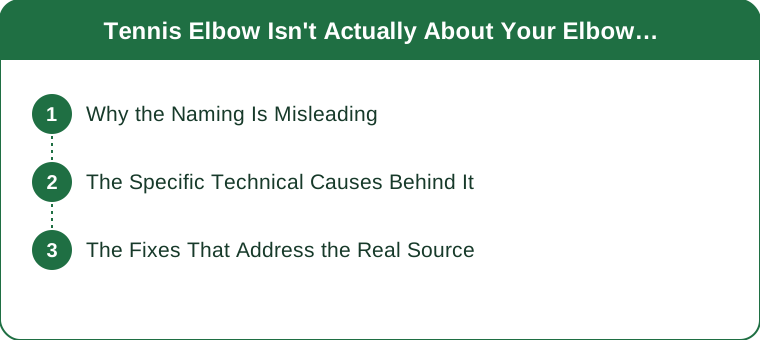
Naming an injury for the location of pain rather than the mechanical origin is common, and usually harmless. Here it isn’t, because it points treatment at the wrong place. Interventions focused narrowly on the elbow joint tend to give less durable relief than approaches that address forearm and grip mechanics directly.
What actually causes it on court?
Five specific, identifiable, largely fixable mechanical issues:
- Excessive grip tension. Squeezing hard throughout the stroke overloads the forearm extensors far more than a relaxed grip that firms only at contact.
- Wrist-led power. Relying on a wrist snap for pace instead of generating force from legs, torso, and shoulder loads the forearm tendons specifically.
- Late backhand contact. Meeting the ball behind the ideal contact point forces the forearm to do corrective work from a mechanically disadvantaged position.
- Equipment mismatch. A grip size that doesn’t fit your hand or string tension that’s too stiff increases the shock transmitted to the forearm on every ball.
- Volume spikes. Ramping up frequency or intensity faster than tendon can adapt — the same pattern behind most overuse injuries.

What Nobody Tells You
Grip tension is mostly a nerves problem. Players grip hardest when they’re tight in a match, which is exactly when they’re also swinging hardest. The technical fix and the mental fix are the same fix.
It usually starts on the backhand, even for forehand-dominant players. The extensor loading pattern is far more punishing on a one-handed backhand, which is why contact timing there matters more than anywhere else on court.
A brace treats the symptom, not the cause. Counterforce straps can genuinely reduce pain by changing where load transmits, and they change nothing about why the load was excessive. Useful bridge; poor destination.
Rest alone often disappoints. Tendons respond better to progressive, tolerable loading under guidance than to complete inactivity. Six weeks off frequently returns you to the same court with the same mechanics and the same result.
Pickleball produces a different version. The shorter paddle and wrist-heavy stroke shift the loading pattern, which is why the risk profile between the two sports isn’t identical.
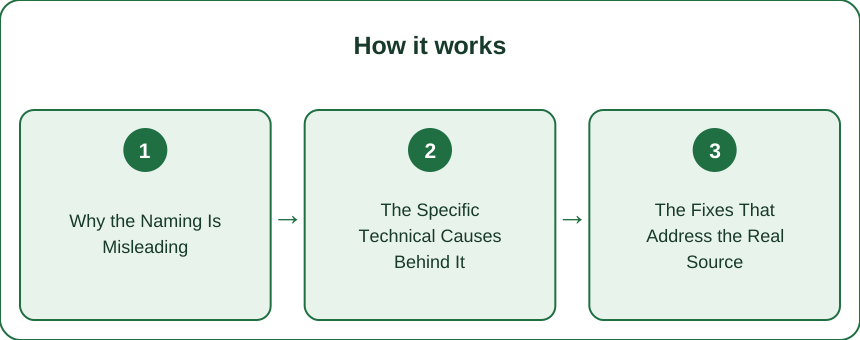
How do you fix the actual source?
Train a relaxed grip. The goal is a loose hold through the swing that firms briefly at ball contact. Most players find this costs them nothing in pace and a great deal in fatigue.
Move power generation to the body. Rotation and legs rather than wrist snap. This directly reduces forearm tendon load on every single ball, which compounds fast over a two-hour session.
Correct backhand contact timing. Earlier, more consistent contact — worth a few sessions with a coach, because it’s genuinely hard to self-diagnose.
Get equipment checked properly. Have a professional verify grip size and string tension against your swing and hand size instead of assuming factory defaults suit you.
Progress volume gradually. After any break, rebuild playing frequency in steps rather than jumping back to full volume. Our prevention guide covers sensible ramp rates.
When to see a professional: persistent pain lasting more than a few weeks, pain that wakes you at night, weakness gripping ordinary objects, or numbness and tingling in the hand all warrant assessment by a physician or physical therapist. Numbness in particular can indicate nerve involvement rather than simple tendinopathy, and that’s a different treatment path entirely. A supervised loading program is also considerably more effective than guessing at exercises from the internet — including this page.
FAQ
How long does tennis elbow take to heal?
Tendon healing is slow — commonly several months rather than several weeks, and longer if the mechanics that caused it don’t change. A structured recovery timeline with progressive loading tends to beat rest-and-hope by a wide margin.
Can I keep playing with tennis elbow?
Sometimes, at reduced volume and with corrected mechanics, under professional guidance. Playing through it with the same grip and the same stroke is how a six-week problem becomes a six-month one.
Does a counterforce brace actually work?
It can reduce pain during play by shifting where load transmits along the forearm. Treat it as a bridge while you fix grip, stroke, and equipment — not as the fix itself.
TL;DR:
- It’s a forearm extensor tendon overuse injury, named for the pain location rather than the mechanical origin — which is why non-players get it too.
- Five causes: excessive grip tension, wrist-led power, late backhand contact, grip-size or string-tension mismatch, and sudden volume increases.
- Fixes target mechanics: relaxed grip that firms at contact, body-driven power, earlier backhand contact, professionally checked equipment, gradual volume progression.
- Braces manage symptoms; they don’t address load.
- Rest alone often fails — progressive loading under guidance works better.
- Night pain, grip weakness, or numbness means see a physician or physical therapist rather than self-managing.
See It in Motion
Seen here: UPF 50+ Pleated Running Skort with 26” Leggings & Pockets — shop similar styles on bubblelime.com
Keep Reading
This article is for general informational purposes only and is not medical advice. It is not a substitute for professional diagnosis or treatment. Always consult a qualified healthcare provider about your individual situation, especially before making significant changes to your diet or exercise routine.